
Questions and answers
Here you will find all the most frequently asked questions from our website, along with their answers.
Questions and answers about the FTA portal
Registration and login
You can access the FTA portal via the FTA website or via the application overview on the ePortal.
The FTA recommends using the AGOV government login to log in. This will gradually replace the CH-Login by spring 2026.
To use the FTA portal, you must log in and submit an application for businesses or taxable persons. You must then redeem the activation code sent to you. These steps are carried out via the ‘Apply for authorisation’ option under the main navigation heading ‘New authorisations’.
If you cannot find the company you are looking for, you can submit a request to add this company via the manual registration process. You will find the relevant options in the ‘Find companies or individuals’ step.
The AGOV government login does not use traditional passwords. For more information, see ‘AGOV explained in simple language’.
With CH-Login, you can reset your password using the ‘Forgotten password’ option.
Activation and invitation codes
The activation code is used for the initial registration of a company on the FTA portal. This code is sent by post to the company’s registered address. The company decides which person will redeem the code. The activation code is valid for 90 days.
Once a company is registered on the FTA portal, an administrator can add further users to the company using an invitation code. The invitation code is managed by the administrator. Its validity can be set individually and is valid for a maximum of 90 days.
Both codes can be redeemed on the FTA portal under ‘New authorisations’ in the ‘Activate code’ section.
In the main menu, click on ‘New Authorisations’ and then on ‘Request authorisation’. You will then need to complete the onboarding process.
The registration letter will then be sent by post to the company’s registered address.
Yes. Go to ‘New Authorisations’ and select the company. In the information box, you will find the option ‘Resend activation code by post’.
If your code is no longer valid, go to ‘New authorisations’ and select the company. In the information box, you will find the option ‘Resend activation code by post’.
Applications from companies not entered in the commercial register are reviewed by the FTA. This review may take a few days.
You can view the status of your application in the main menu under ‘New authorisations’. In the ‘Ongoing authorisation requests’ section, you will find all pending applications and their statuses. You can view further details by clicking on the entry.
Authorisations and roles
An administrator can grant their organisation’s permissions to other users or administrators.
A user can manage transactions for the organisation within the scope of their permissions, but cannot pass these rights on to others. A user may be authorised for multiple services within the same organisation, as well as for multiple organisations.
You can find your authorisations in the main menu under ‘My authorisations’. Select the company there. The services you are authorised to use will then be displayed.
You can request new authorisations via ‘New authorisations’ and the ‘Request authorisation’ option.
To update authorisations, go to ‘My authorisations’, select the service, and you will be redirected to the Federal Government’s ePortal. If you are an administrator, you can make the changes yourself. Otherwise, please contact the relevant administrator.
You can revoke authorisations via the user management section in the Federal Government’s ePortal. To do this, first click on ‘My authorisations’ in the FTA portal and select the service. This will take you to the ePortal. Please note that only administrators can make these changes.
Sure, an administrator can appoint other administrators.
However, a service must always have at least one administrator. The last remaining administrator cannot therefore remove him/herself.
You can submit an authorisation request as part of the authorisation process. To do this, go to ‘New authorisations’ and select ‘Request authorisation’.
The FTA recommends that, initially, at least one internal employee, managing director or company owner be linked to the FTA portal. Tax representatives should only be added afterwards, and only as additional administrators. This ensures that the company retains control over access and authorisations at all times.
You can view the status of your requests under ‘New authorisations’ in the ‘Pending authorisation requests’ section.
Requests that have already been submitted cannot be deleted or withdrawn. They are stored for three years and then automatically deleted.
If necessary, you can request a new activation code for a company. To do this, open the request and select ‘Resend activation code by post’.
Features and services
The following services can currently be activated via the FTA portal, provided your company is eligible:
- Manage companies and individuals:
Manage administrative rights for companies/individuals, authorisations and services - Anticipatory Tax (Swiss Withholding Tax) and stamp duties:
Declaration anticipatory and refund application for Anticipatory Tax (Swiss Withholding Tax), as well as the declaration of stamp duties for companies domiciled in Switzerland - Reporting VAT:
Reporting VAT, rectifications, annual rectifications - Radio and TV fee:
Bill for the Radio and TV fee - GloBE Information Return (GIR)
The following services are not yet integrated into the FTA portal and must be managed via the specific applications:
- Automatic Exchange of Information (AEOI)
- Country-by-Country Reporting (CbCR)
- Spontaneous Exchange of Information (SIA)
- Reclaim Anticipatory Tax (Swiss Withholding Tax) for abroad domiciled person
- Manage companies and individuals:
At present, company details can only be updated to a very limited extent via the FTA portal. This is because certain details are taken from the cantonal commercial registers and must be amended there. If you wish to notify us of a change of address and/or a change of name, please use the appropriate form.
For data protection reasons, only publicly available company data can be displayed. As a result, it may happen that a company you are looking for cannot be found.
Please also note that newly registered companies do not appear on the FTA portal immediately; there is a certain delay. As we import this data, it may take a few days for a company to appear in the search results after it has been registered.
Open ‘My Authorisations’ and select the company.
To add another service, click on ‘Add service’. Depending on the authorisation level, the service will either be activated immediately or an authorisation process will be initiated, followed by a letter being sent.
Open ‘My authorisations’ and select the company.
A service can only be deleted if the service in question supports this feature and you are an administrator for that service. Doing so will remove all user authorisations for that service.
If you remove a service, it will disappear from the overview and all users’ access rights to that service will be revoked. However, this does not mean that the company is no longer registered for that service. Any existing tax obligations remain in force and must be fulfilled.
In the main menu, click on ‘New Transactions’. By default, you will see all transactions that can be initiated without being linked to a specific company. These include: Business Registration certificate, Certificate of registration and VAT registration. If you use the search field to select a company with which you are linked, you will be shown all transactions that are relevant to that company and for which you have authorisation.
Security and data protection
Your data will be processed and protected in accordance with the applicable legal requirements, in particular the Swiss Data Protection Act (DSG). The FTA takes technical and organisational measures to protect your data from unauthorised access. Your data will only be stored for as long as is necessary to process transactions or to comply with statutory retention periods.
For security and audit trail purposes, technical logs are generated (e.g. access times or system events). These are used for security, fault analysis and the operation of the portal. Access to this data is restricted to authorised personnel within the scope of their duties.
If you suspect that your account has been misused or that unauthorised access has taken place, please contact the FTA’s technical support team immediately (+41 58 461 61 11) or use the contact form on the portal.
Technical questions
To use the portal, you will need a modern web browser. We support the latest versions of Chrome, Firefox, Edge and Safari. Internet Explorer is not supported.
The page may not display correctly due to an outdated browser, disabled browser features, or network/security filters. Please use the latest version of a supported browser. Temporary maintenance work may also cause some restrictions.
First, refresh the page and check that you are using an up-to-date browser. If necessary, clear your browser cache or try using a different browser. If the problem persists, please contact FTA Support (+41 58 461 61 11).
Feedback and comments
You can submit feedback or suggestions for improvement using the form. Your feedback helps us to continuously improve the FTA portal.
Questions and answers about VAT
Value Added Tax (VAT) is a general consumption tax levied by the federal government.
VAT is based on the idea that those who consume something make a financial contribution to the state. However, it would be too complicated if every citizen had to account for all consumption with the state. The tax is therefore levied on businesses (producers, manufacturers, traders, craftspeople, service providers, etc.), which in turn are required to pass the VAT on to the consumer by including it in the price or listing it as a separate item on the invoice.
Yes, from 1 January 2025, VAT reporting must be done online.
Questions & answers to the tax liability
A business with its headquarter in Switzerland is generally liable to tax if it:
- independently performs a professional or commercial activity,
- acts externally under its own name and
- has the aim of sustainably earning income from supplies of goods and services.
If one of following turnover limits is exceeded in the process, we strongly recommend checking whether mandatory tax liability applies by completing the Questionnaire (registration - German version):
- For non-profit, voluntarily-run sporting or cultural associations: at least CHF 250 000 turnover from supplies of goods and services in Switzerland and abroad which are not exempt from tax without credit.
- For charitable institutions: at least CHF 250 000 turnover from supplies of goods and services in Switzerland and abroad which are not exempt from tax without credit.
- MWST-Branchen-Infos 19 Gemeinwesen, Ziffer 2.1 Grundsatz - German version
- For public bodies: at least CHF 100 000 turnover from taxable goods and services for persons other than public bodies;
- For businesses not yet mentioned: at least CHF 100 000 turnover from goods and services in Switzerland and abroad which are not exempt from tax without credit.
- The organisation of a one-off sporting, cultural or festive event (lake festivals, village fairs, yodelling festivals, equestrian events, etc.) with budgeted taxable receipts of at least CHF 100 000 from catering services, sales stands for food, advertising, sponsorship etc.
If none of the defined turnover limits is reached, a business may voluntarily submit to tax liability (see «Waiver of exemption from tax liability»).
Tax liability for businesses with their headquarters abroad:
In principle, the same conditions apply as for domestic businesses (see above). However, foreign businesses can become liable to tax only if they supply goods or services in Switzerland. They are also exempt from tax liability if they provide only certain goods or services in Switzerland (e. g. goods or services exempt from tax with credit). If goods or services are provided in Switzerland, we recommend that you complete the Questionnaire (registration) in order to check the business's tax liability.
Foreign businesses' permanent establishments in Switzerland:
The same rules apply as for businesses with their headquarters in Switzerland, i.e. they are considered to be independent taxable entities and, depending on the amount of turnover, are liable to tax. If a foreign business has more than one permanent establishment in Switzerland, these are grouped together and considered to be one independent taxable entity.
In order to determine the turnover limits, revenue generated with the following goods and services is to be taken into account:
- the domestic supply of taxable goods and services,
- the supply of goods and services abroad, if these would be taxable had they been supplied domestically,
- the domestic supply of goods and services which are exempt from tax with credit.
In order to determine the turnover limits, the following revenue and cash flows should not be taken into account:
- domestic revenue from goods and services exempt from tax without credit,
- revenue from the supply of goods and services abroad which would be exempt from tax without credit had they been provided domestically,
- receipts which were not generated by supplying goods or services (non-considerations in accordance with Art. 18 para. 2 of the VAT Act, e. g. donations, subsidies),
- receipts generated in the non-business area.
If the turnover thresholds from supplies of goods and services which are not exempt from tax without credit are not reached according to the «Tax liability» Title, the legal entity engaged in business can still register as a taxpayer. This applies to foreign businesses only if they supply goods or services on Swiss territory.
Voluntary tax liability is possible for the beginning of a tax period at the earliest.
Goods and services which are exempt from tax without credit can, in principle, still be invoiced with VAT included (option). However, this option is not possible:
- for certain goods and services in the insurance field (Art. 21 para. 2 no. 18 of the VAT Act),
- for various forms of turnover in the field of financial transactions (Art. 21 para. 2 no. 19 of the VAT Act),
- for turnover in betting, lottery and other games of chance involving wagers, to the extent they are subject to a special tax or other duties (Art. 21 para. 2 no. 23 of the VAT Act),
- for businesses which apply net tax rates or flat tax rates.
If the following goods and services are used by the recipient exclusively for residential purposes, the option is also not possible:
- transfer and creation of rights in rem in immovable property (e. g. sale of a single family house or apartment building for residential purposes) or goods and services of communities of condominium owners (Art. 21 para. 2 no. 20 of the VAT Act),
- provision of immovable property and parts of immovable property for use or exploitation (Art. 21 para. 2 no. 21 of the VAT Act), e. g. letting an apartment to a private individual for residential purposes.
How does the option work?
The taxation of goods and services exempt from tax without credit is opted for if VAT is clearly shown on invoices or receipts (e. g. the 2,5 % tax rate is indicated on a cinema ticket) or declared in the VAT return.
For domestic businesses that commence their activity or extend their business activity by taking over a business or opening a new business division, mandatory tax liability begins with the commencement of this activity, if at the time it is to be assumed based on the circumstances that the relevant turnover threshold will be reached within the following twelve months. Existing domestic businesses which were previously exempt from tax liability will imperatively become liable to tax after the end of the financial year in which the relevant turnover threshold was reached.
Foreign businesses which supply goods or services for the first time on Swiss territory will imperatively become liable to tax if at the time it is to be assumed based on the circumstances that the relevant turnover threshold will be reached within the following twelve months. Foreign businesses which have previously supplied goods or services domestically will become liable to tax after the end of the financial year in which the relevant turnover threshold is reached.
For domestic businesses, tax liability ends with the termination of the business activity or, in the case of the liquidation of assets, with the conclusion of the liquidation process. For foreign businesses, tax liability ends at the end of the calendar year in which the last goods or services were supplied on Swiss territory (this is the case when no further domestic goods or services will be supplied before the end of the calendar year and it can be assumed with a high level of probability that no domestic goods or services will be supplied in the following calendar year). In both these cases, the taxpayer must deregister with the FTA in writing within 30 days.
If the qualifying turnover of the taxable person does not reach the turnover threshold of CHF 100 000 and it is expected that the qualifying turnover will not be reached in the following tax period either, taxpayers may exempt themselves from tax liability and be deleted from the VAT register. De-registration is not possible before the end of the first tax period in which the qualifying turnover is no longer reached; failure to deregister is deemed to be a waiver of the exemption from tax liability. Deregistration requests must be submitted to the FTA within 60 days of the end of the tax period in order for these to be accepted.
The valley areas of Samnaun and Sampuoir are outside the Swiss customs territory and are considered foreign territory for the purpose of deliveries of goods. This means deliveries from or within Samnaun and Sampuoir are either excluded from tax or classified as deliveries made abroad.
However, in terms of services, the valley areas of Samnaun and Sampuoir are deemed to be part of Swiss territory. This means services provided to or in Samnaun and Sampuoir (e. g. hotel and restaurant services or advisory services) are subject to tax.
Businesses with their headquarter in the Principality of Liechtenstein which become liable to tax should contact the Liechtenstein tax administration at the following address:
Liechtensteinische Steuerverwaltung
Mehrwertsteuer
Aeulestrasse 38
Postfach 684
9490 Vaduz
Questions & answers about VAT registration
Here you will find answers to frequently asked questions about registering for VAT.
You need a browser and a PDF reader to use our online service. The online registration is optimised for the following browsers:
- Internet Explorer (from version 8.0)
- Firefox (from version 3.5)
- Safari (from version 4)
- Chrome (from version 4)
Online registration is based on the Web 2.0 standard. AJAX technology (AJAX = Asynchronous JavaScript and XML) is used for the ongoing validation of the input. To do this, your browser must allow the execution of JavaScript (activation in the "Settings" section of the browser).
As a rule, these have the legal form of a simple partnership. If the simple partnership is already entered in the UID register, you will find your company in the search bar. For companies without a UID, please click on "manual". Then select "Simple partnership".
You can cancel all entries with the «Restart» button. Start a new registration or close the page if you want to cancel the entry.
Once the online VAT declaration has been submitted, confirmation of the submission will be displayed, together with the PDF of your declaration. You can download the PDF for your records.
The language can be changed at the top right of the navigation bar. You can choose German, French or Italian.
Please note that it may take a few days for your company to appear in the list. Please try again later.
The former AHV number became the social insurance number and was given a new format. It consists of 13 digits. The easiest way to find your social insurance number (AHV number) is on your AHV-IV insurance certificate or your health insurance card.
Once you have submitted the online VAT return, it is no longer possible to make corrections. Before submitting, make sure that you have entered all the data completely and correctly.
We recommend that you have the following documents and details to hand:
- Details of the company/enterprise such as an extract from the commercial register and VAT number.
- For legal forms such as sole proprietorship, simple partnership, association or foundation, you will need the national insurance number. This can be found on your AHV/IV insurance certificate or your health insurance card.
- Turnover forecast for the first financial year or, in the case of already active companies, balance sheet and income statement for the last six financial years at most.
- Foreign companies: You will need the details of your tax representative to complete the declaration of authorisation.
Your application will be checked quickly. You will receive a written response from us within a few days.
Questions and answers about paying VAT
You can request it in writing or by phone from the responsible Debt Collection & Partner Data Division.
No, as VAT is a self-declared tax, the declaration and payment must be made without being requested to do so. In accordance with Article 86 paragraph 1 of the VAT Act, the tax claim must be settled within 60 days of the end of the reporting period.
Within 60 days of the end of the reporting period: by means of a QR invoice or via the payment address.
You can request it in writing or by phone from the responsible Debt Collection & Partner Data Division.
If the tax owed for a reporting period is paid after the due date in accordance with Art. 86 para. 1 of the VAT Act (end of the reporting period + 60 days), interest on late payment is due automatically, without any reminder (Art. 87 para. 1 VAT Act).
The interest rates are uniformly regulated in the Ordinance of the Federal Department of Finance (FDF) on interest rates for late payments and refund interest on duties and taxes (Interest Rate Ordinance FDF).
Once the outstanding amount, interest on late payment, and debt collection costs have been fully paid, the FTA will have the debt collection record removed from the register.
Questions and answers about the corporate radio and television fee
Since 1 January 2019, the new device-independent fee for radio and TV has been levied on households and businesses.
It replaces the receiver-dependent levy, which expired at the end of 2018. Companies subject to VAT in Switzerland (with their registered office, place of domicile or permanent establishment in Switzerland) with a global turnover of at least CHF 500 000 are subject to the RTV fee. They automatically receive an annual invoice from the Federal Tax Administration.
Further information on the RTV fee can be found on the following pages.
If a company (with registered office, domicile or permanent establishment in Switzerland) is subject to VAT and generates an annual global turnover of CHF 500 000 or more, this company is subject to the radio and television fee.
Legal basis:
The radio and television fee is not device-dependent. Consequently, undertakings with no means of radio or television reception also pay the radio and television fee.
Undertakings without registered office domicile or permanent establishment in Switzerland that supply goods and services in Switzerland are not subject to the corporate fee.
Undertakings with registered office, domicile or permanent establishment in Switzerland which are registered with the VAT and have a total turnover of CHF 500 000 (without VAT) or more are subject to the corporate fee.
According to the dual-entity principle in Swiss VAT law applicable in cross-border affairs, undertakings domiciled abroad and their domestic permanent establishments in Switzerland are each independent taxable entities. Multiple domestic permanent establishments in Switzerland of undertakings domiciled abroad are considered as one taxable subject.
With regard of the corporate fee, the cumulative turnover of all domestic permanent establishments in Switzerland is decisive for the corporate fee liability and tariff determination.
Due to international contractual obligations, undertakings domiciled abroad are exempt from the corporate fee. Even if registered with the VAT and goods and services are supplied in Switzerland.
The radio and television fee will be collected from 1 January 2019. It will replace the earlier device-dependent reception fee.
The amount of the corporate fee depends on the company's turnover without VAT (total turnover, including exports, services abroad, excluded turnover, notification procedure, land sales etc.). Your company will be allocated to a tariff category based on the amount of turnover. Companies whose global turnover is less than CHF 500 000 will not have to pay the corporate fee.
The FTA was designated as the corporate fee collection office by Parliament, because the fee amount and liability will be linked to turnover and the FTA can access this data in the simplest and most reliable way through the VAT register.
Questions & answers about billing
Invoices are issued between February and October, as soon as the FTA has the previous year's turnover. An invoice will automatically be issued if your company is subject to the fee.
Households as well as companies which are subject to VAT and have a turnover of CHF 500 000 or more are subject to the fee. Owners of sole proprietorships pay the household fee to Serafe AG as a household member. If a household member's company meets the requirements for corporate fee liability, the company receives an invoice for the corporate fee from the FTA, irrespective of whether the company is a sole proprietorship or a legal entity. The household and corporate fees are payable even if the business premises and home are in the same property.
The radio and television fee is not subject to VAT.
The bill for the corporate fee has to be paid within 60 days from the time of issue.
Request a payment deadline or payment plan from your contact in the FTA's Collection Division. Payment facilities may lead to interest on arrears.
If you do not pay the radio and television fee on time, you will receive a reminder. A payment plan request can be submitted via this link: Submit a proposal for a payment plan.
If you do not pay the bill despite the reminder, debt enforcement proceedings will be initiated.
If you agree with the debt enforcement proceedings, pay the amount ordered. You can do this directly at the debt enforcement office or request a payment slip from the FTA.
If you contest the debt enforcement proceedings, you have to file an objection within ten days of the payment summons being notified. This must be done at the debt enforcement office. You do not have to substantiate the objection. However, if you wish to substantiate your objection, please send the rationale to the FTA and not to the debt enforcement office.
Various costs have to be borne by the debtor, e.g. debt enforcement costs are incurred with debt enforcement proceedings. The debt enforcement office charges those costs to the FTA.
File an objection within ten days of the payment summons being notified. To counter the objection, the FTA can issue an order based on its status as an authority.
The FTA will have the debt collection proceedings deleted from the debt collection register when the entire sum being claimed has been paid (basic claim, debt enforcement costs, default interest) and you have expressly requested this deletion in writing.
Questions & answers about the fee liability
If a company (with registered office, domicile or permanent establishment in Switzerland) is subject to VAT and generates an annual global turnover of CHF 500 000 or more, this company is subject to the radio and television fee.
Legal basis:
The radio and television fee is not device-dependent. Consequently, undertakings with no means of radio or television reception also pay the radio and television fee.
Undertakings without registered office domicile or permanent establishment in Switzerland that supply goods and services in Switzerland are not subject to the corporate fee.
Undertakings with registered office, domicile or permanent establishment in Switzerland which are registered with the VAT and have a total turnover of CHF 500 000 (without VAT) or more are subject to the corporate fee.
According to the dual-entity principle in Swiss VAT law applicable in cross-border affairs, undertakings domiciled abroad and their domestic permanent establishments in Switzerland are each independent taxable entities. Multiple domestic permanent establishments in Switzerland of undertakings domiciled abroad are considered as one taxable subject.
With regard of the corporate fee, the cumulative turnover of all domestic permanent establishments in Switzerland is decisive for the corporate fee liability and tariff determination.
Due to international contractual obligations, undertakings domiciled abroad are exempt from the corporate fee. Even if registered with the VAT and goods and services are supplied in Switzerland.
The radio and television fee will be collected from 1 January 2019. It will replace the earlier device-dependent reception fee.
The radio and television fee will no longer be device-dependent from 1 January 2019. Those companies who do not listen to the radio or watch television also benefit indirectly from public-service radio and television broadcasting. For example, radio and TV provide economic information, stock exchange and business news, consumer affairs programmes and traffic information, provide national and regional advertising platforms and contribute to the functioning of democracy with their reporting. Public-service broadcasting helps to create a stable framework environment in multilingual Switzerland, which is also ultimately beneficial for each individual company.
No. Provided your company meets the requirements for fee liability, you will automatically receive a bill from the FTA.
The fee liability is based on the entry in the VAT register. An exemption for a consortium is not provided in the statutory provisions.
Questions & answers about the tariff categories
The amount of the corporate fee depends on the company's turnover without VAT (total turnover, including exports, services abroad, excluded turnover, notification procedure, land sales etc.). Your company will be allocated to a tariff category based on the amount of turnover. Companies whose global turnover is less than CHF 500 000 will not have to pay the corporate fee.
The corporate fee is calculated on the basis of the company's total turnover, i.e. tax-exempt items such as exports, supplies abroad and non-taxable supplies (in accordance with Article 21 of the VAT Act etc.) are included. The definition of VAT eligibility is not relevant to the corporate fee. By using total turnover as the authoritative basis, all companies are treated equally in terms of the collection of the corporate fee.
The FTA was designated as the corporate fee collection office by Parliament, because the fee amount and liability will be linked to turnover and the FTA can access this data in the simplest and most reliable way through the VAT register.
A company becomes liable to the fee the year after the one in which it first exceeds the relevant turnover threshold. If a company generated an annual turnover of CHF 500 000 or more the previous year, it is liable to the fee the following accounting year.
Yes. Any entity entered in the VAT register during the current year is subject to the fee if a turnover of CHF 500 000 or more was generated the preceding year. The full fee is payable, irrespective of how long the company was entered in the VAT register in the current year. To compensate for this, a newly entered company is not subject to the fee in its first year in the VAT register.
No. Assessment of the corporate fee is based on the past, which is why there is no refund. A company is liable to the fee based on the previous year's actual turnover. Any entity entered in the VAT register during the current year is subject to the fee if a turnover of CHF 500 000 or more was generated the preceding year. The full fee is payable, irrespective of how long the company was entered in the VAT register in the current year. To compensate for this, a newly entered company is not subject to the fee in its first year in the VAT register.
If your company applies the simplified calculation of the input tax reduction for subsidies, the amount of the subsidy should be declared in position 900 instead of 200. Important: The input tax reduction calculated by the subsidy (= 107,7 %) at the standard rate must be declared in position 420 (VAT info 05 Subsidies and donations).
Banks, insurances and pension funds that calculate their input tax based on the bank or insurance flat rate can waive the declaration of turnover exempted from the tax if they voluntarily choose the highest tariff category 18 of the company tax (Art. 68a para. 1 and Art. 70 RTVA in conjunction with Art. 67b RTVA). This simplification must be selected by the bank or insurance company on ePortal under «Radio and TV fee» by 15 January of the respective year and is valid until revoked. Any turnover corrections have no effect on the tariff level.
Questions and answers on Anticipatory Tax (Swiss withholding tax)
Anticipatory Tax (Swiss Withholding Tax) in Switzerland is a tax levied at source by the federal government on the revenue from movable capital assets (particularly interest and dividends), on winnings from gambling as defined in the Gambling Act, on winnings from lotteries and games of skill to promote sales and on certain insurance benefits. The primary purpose of this safeguard tax is to combat tax evasion; taxpayers are prompted to disclose to the authorities responsible for direct taxes the earnings and investment income subject to Anticipatory Tax (Swiss Withholding Tax), as well as the assets on which the taxable gains were realised.
Under certain conditions, Anticipatory Tax (Swiss Withholding Tax) is refunded in cash or by offsetting it against cantonal and communal taxes. The tax is not definitively charged to taxpayers domiciled in Switzerland who declare their earnings subject to Anticipatory Tax (Swiss Withholding Tax) and the corresponding assets, or show them in their accounts.
This Anticipatory Tax (Swiss Withholding Tax) mechanism can be illustrated as follows:
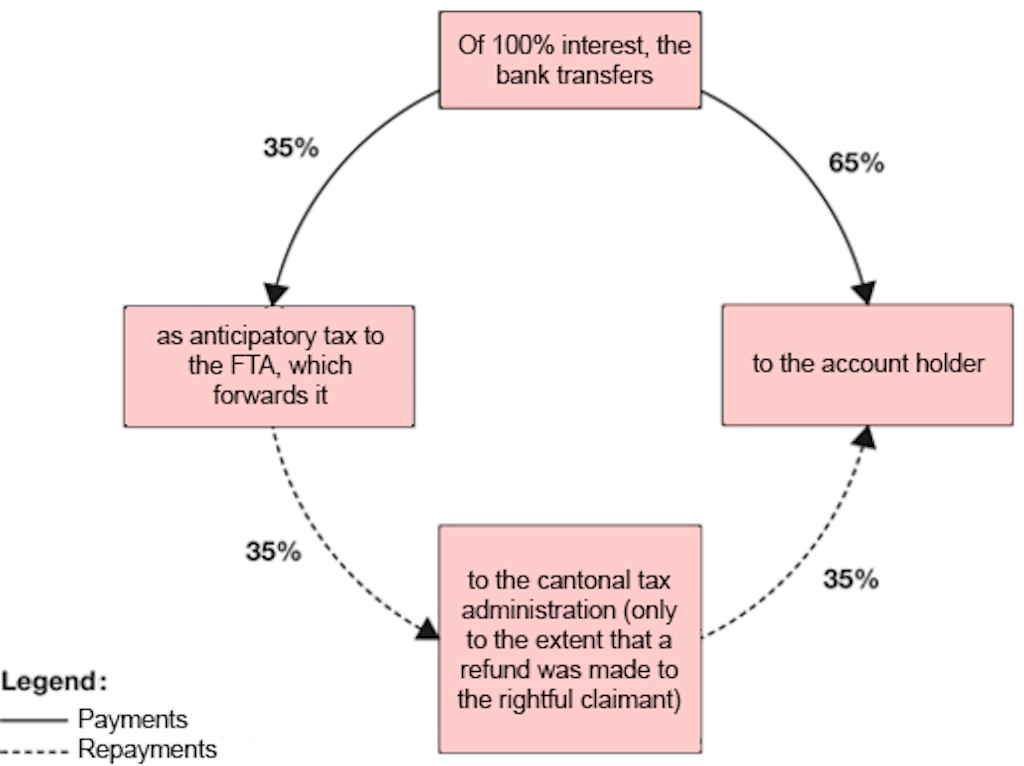
Anticipatory Tax (Swiss Withholding Tax) is an impersonal tax, i.e. it is levied regardless of whether the recipient of the taxable benefit/payment has the ability to pay it.
The tax rate is
- 35% for investment income and lottery winnings
- 15% for life annuities and pensions
- 8% for other insurance benefits
Those liable to the tax are domestic debtors (e.g. banks) of taxable benefits/payments. They have to pay the tax on the taxable benefit/payment and pass it on to the recipient (e.g. accountholder) by reducing the benefit/payment accordingly.
The tax debtor has to spontaneously register with the Federal Tax Administration, submit the prescribed statements and supporting documents, and at the same time pay the tax (self-assessment principle).
If tax amounts are not paid on time, default interest is payable without a reminder being issued.
Recipients of taxable benefits/payments domiciled in Switzerland who correctly complete their tax returns are entitled to a Anticipatory Tax (Swiss Withholding Tax) refund under certain conditions.
A refund is granted in particular to:
- Individuals domiciled in Switzerland, provided they duly declared the assets and the investment income earned on them in the relevant tax return for cantonal and communal taxes. The cantons are responsible for refunding Anticipatory Tax (Swiss Withholding Tax) to individuals, whereby the amount to be refunded is generally offset against cantonal taxes.
- Legal entities domiciled in Switzerland, provided they duly recognised the earnings subject to Anticipatory Tax (Swiss Withholding Tax) as revenue. Anticipatory Tax (Swiss Withholding Tax) is refunded directly to legal entities by the Federal Tax Administration.
The taxpayer has to request a Anticipatory Tax (Swiss Withholding Tax) refund within three years from the end of the calendar year in which the taxable benefit/payment became due.
If the aforementioned conditions are not met, either no refund entitlement arises or else any existing entitlement is forfeited. Moreover, a refund is inadmissible in all cases where it would lead to tax avoidance.
This was the legislator's intention, as the purpose of Anticipatory Tax (Swiss Withholding Tax) is to combat tax evasion by putting fraudsters at a disadvantage to honest taxpayers, with the result that fraudsters have to bear at least a minimum tax burden in this way.
Taxpayers who do not exercise their right to a refund or who forfeit it by violating their tax obligations are not released from the obligation to pay the direct taxes due on the assets and investment income concerned.
Anticipatory Tax (Swiss Withholding Tax) generally constitutes a final charge for benefit/payment recipients domiciled abroad. However, persons whose country of domicile has entered into a double taxation agreement with Switzerland are entitled to a full or partial Anticipatory Tax (Swiss Withholding Tax) refund, depending on what is provided for in the agreement, provided they meet the conditions set out in the agreement in question.
Rulings/advance tax rulings
Wherever possible, please submit ruling queries electronically to the email address ruling.dvs@estv.admin.ch, or else send them by post to the address indicated below. If the query is submitted electronically, it is not necessary to additionally submit the request in paper form.
Federal Tax Administration
Main Division DAS
Ruling DAS
Eigerstrasse 65
3003 BernThe formal and material requirements for a ruling request are stated in the Communication 011 of 29 April 2019.
You will receive an electronic confirmation as soon as your ruling request is registered.
If further information is required or if there are any uncertainties, the person responsible for processing your request will contact you. Until then, there is no need for you to follow up the status of your request.
If further documents are to be submitted in the meantime, they can be sent to the shared email address in the same way as the original ruling query. They will be forwarded internally without delay.
The processing time may vary depending on the complexity of the case and the current workload.
Further information
The External Audit Division of the Main Division for Federal Direct Tax, Anticipatory Tax (Swiss Withholding Tax) and Stamp Duty primarily checks whether any benefits in kind were provided. The company does not usually receive a report following the audit.
The FTA assesses the value of a company for Anticipatory Tax (Swiss Withholding Tax) and stamp duty purposes using the indirect goodwill valuation method (intrinsic value plus capitalised earnings divided by 2). The valuation method must be appropriate. Using the indirect goodwill valuation method to determine market value can yield appropriate results for SMEs. Otherwise, when determining an arm's length sales price, preference should be given to forward-looking methods (discounted cash flow); backward-looking methods such as the indirect goodwill method are not suitable for this purpose, or only under certain conditions (see Federal Supreme Court decision of 18.9.2013 / 2C_310/2013).
The due date of a dividend is determined at the company's annual general meeting. If no dividend due date is defined, it is the date of the annual general meeting (see art. 21 para. 3 of the ATO).
If the dividend is not distributed according to the same proportion of the nominal share capital for all participants, this must be declared on the form and the identity of the beneficiaries must be disclosed on the second page, listing their name, exact address and share of the dividend.
After the VAT and DAS main divisions have verified the deletion, the FTA will forward its approval of the deletion directly to the commercial registry.
In order for the FTA to be able to forward its approval of the deletion of your company to the relevant commercial registry, the DAS requires the following documents for verification:
- annual financial statements for the last five financial years, including the closing balance sheet prepared by the liquidator;
- declaration of any liquidation surplus using form 102;
- documentation concerning the sale of stakes, securities, real estate or other major sales or private withdrawals of assets; and
- contact details (telephone number and email address) for queries.
Please send these documents by post to the following address:
Federal Tax Administration
Tax Collection Division (DVS-ER)
Eigerstrasse 65
3003 BerneTo assess the appropriate interest rate for advances or loans from holders of participations or related third parties, the FTA uses the maximum interest rates published annually in its circular (in German).
For business loans, including for larger loan amounts, the higher rate can be charged for the first CHF 1 million. The lower maximum rate is applied to the remaining amount (>CHF 1 million).
Intragroup loans granted as part of a cash pooling arrangement or the interest paid on such loans is generally accepted by the FTA, provided that the taxpayer can demonstrate that they are not long-term loans. Therefore, it is generally not permitted to use cash pooling to finance certain transactions, particularly the acquisition of financial interests, fixed assets and dividend payments. In practice, certain indicators are used to assess whether a cash pooling transaction is justified. Based on these indicators and other characteristics, such as the purpose of the financing (e.g. dividend payment), the taxpayer must demonstrate that the transaction is actually justified within the framework of cash pooling in accordance with the arm's length principle. Otherwise, the transaction is qualified as a long-term loan. In this case, the interest rates specified in the FTA circulars apply.
The interest rates on cash pool balances must stand up to a third-party comparison. As a general rule, the synergy effects from cash pooling must benefit all participants – once any costs of the cash pooling have been offset. When setting the level of remuneration, the functions and risks assumed by the participants and the cash pool leader must be taken into account.
Depending on the sector, merchandise deliveries are generally paid for within a period of 30, 60 or 90 days, for example. If the payment period is much longer than customary, the FTA considers the amount in question to be a loan, on which interest has to be paid according to the rates specified in the FTA circular (in German).
The FTA circulars published annually set out the interest rates for advances and loans that are permissible for tax purposes; these are "safe-haven rules". If taxpayers apply these interest rates, they are generally not required to demonstrate compliance with the arm's length principle.
Please refer to section 6, Restructuring in general, of FTA circular Number 29c (in German), capital contribution principle, of 23 December 2022.
As part of its activities, the DAS Main Division of the FTA drafts and publishes circulars, factsheets and guidelines. These documents explain the relevant legal provisions of the Anticipatory Tax (Swiss Withholding Tax) Act and the implementing ordinances in more detail and serve to establish uniform practices.
To the Anticipatory Tax (Swiss Withholding Tax) circulars (in German).
Legal advice
Among other things, the Federal Tax Administration's Main Division for Federal Direct Tax, Anticipatory Tax (Swiss Withholding Tax) and Stamp Duty (DAS Main Division) is responsible for collecting and refunding Anticipatory Tax (Swiss Withholding Tax) (to legal entities domiciled in Switzerland and to eligible legal entities and individuals domiciled abroad). As regards Anticipatory Tax (Swiss Withholding Tax) refunds to individuals resident in Switzerland, the Federal Tax Administration oversees the competent cantonal tax administrations. With regard to the application of the law in specific cases involving individuals, please contact your cantonal tax administration.
If you have legal questions, please contact the DAS Main Division using the Anticipatory Tax (Swiss Withholding Tax) contact form. With regard to the application of the law in a specific case that is to be initiated by the FTA or is already being processed, the corresponding formal requirements and timeframes are to be observed.
Questions and answers on declaring and reporting Anticipatory Tax (Swiss Withholding Tax)
Benefits/payments subject to Anticipatory Tax (Swiss Withholding Tax) can be declared online via our ePortal or, alternatively, using the official physical forms provided by the FTA.
At present, forms 102, 103 and 110 can be filed online via ePortal. As our digital offering is constantly evolving, we recommend that you check our website for updates. Declarations should be made via our ePortal where possible.
The forms available on our website are updated on an ongoing basis. As only the latest version available online is accepted, please ensure that you are always using the latest version. If the FTA finds that a form submitted to it is not compliant or official, it will reject it. Declarations that are not filed via our ePortal must be submitted by post in hard copy, together with the corresponding supporting documents.
No. It is not possible to submit paper forms electronically (i.e. by email) at present. It is still mandatory to post paper forms. However, our partners are free to sign documents digitally. Nevertheless, digitally signed forms must still be printed out and sent to the FTA by post.
Alternatively, forms 102, 103 and 110 can be submitted online via our ePortal. Declarations with the reporting procedure (form 106 and/or 108) are not yet possible. As our digital offering is constantly evolving, we recommend that you check our website for updates.
It is now possible to use the UID (CHE-xxx.xxx.xxx), which can be found in the Central Business Names Index (zefix.ch) by entering the company name.
If you know it, you can also use the FTA ID number (052.xxxx.xxxx). However, the UID is still the best way to identify the company.
For the Principality of Liechtenstein, the FTA ID can be requested from Team 1 of the DAS Collection Division:
Team 1 (Zones 1 - 4)
E-Mail: er01.dvs(at)estv.admin.ch – Phone number : +41 58 465 60 82Anticipatory Tax (Swiss Withholding Tax) is declared and paid in accordance with the self-assessment principle, which is enshrined in Article 38 of the Anticipatory Tax Act (ATA). In addition, under Article 38 paragraph 2 of the WTA the taxpayer must, when tax is due, spontaneously submit the prescribed statement to the FTA, together with the supporting documents, and at the same time pay the tax or file a report in lieu of payment (Art. 19 and Art. 20 of the WTA). The taxpayer alone is responsible for preparing the statement using the official form and paying the amount of Anticipatory Tax (Swiss Withholding Tax) due, or for reporting the taxable benefit/payment.
Can I declare benefits/payments in a foreign currency?
Only companies whose share capital is entered in the commercial register in a foreign currency may declare benefits/payments in that foreign currency. In all other cases, benefits/payments must be converted and declared in CHF.The Anticipatory Tax (Swiss Withholding Tax) owed to the FTA must be paid in CHF.
What exchange rate should I use to convert benefits/payments into CHF?
If benefits/payments are determined or made in a foreign currency, the calculation is based on the average bid/ask rate on the last working day before the due date of the benefit/payment in accordance with Article 4 paragraph 3 of the Anticipatory Tax (Swiss Withholding Tax) Ordinance (the exchange rate can be calculated at the following link: ICTax – Income & Capital Taxes (admin.ch)).Under Article 20 of the WTA, in conjunction with Article 24 et seq. of the WTO, reporting form 105 can be used in the case of the issuance of bonus shares, distribution of dividends in kind or relocation of the headquarters to another country, if it is established that the recipients to whom the tax is to be passed on would be entitled to a Anticipatory Tax (Swiss Withholding Tax) refund and if there are no more than 20 recipients. In this case, there is no need to file an additional form 102, 103 or 110.
If an official audit or check reveals benefits in kind in a previous year, the company may submit form 112 on a one-off basis. In this case, there is no need to file an additional form 102, 103 or 110.
The forms must be submitted to the FTA no more than 30 days after the taxable benefit/payment falls due. In the case of distributions to foreign corporations, a basic request using form 823, 823B or 823C must be submitted beforehand and authorisation to use the reporting procedure must be obtained.
Submission after the deadline will result in a fixed penalty fine.
Anticipatory Tax (Swiss Withholding Tax) tax is a self-assessment tax. As a result, taxpayers must use the official form to spontaneously declare any netting by the cantonal tax administrations to the FTA, provided such correction is relevant for Anticipatory Tax (Swiss Withholding Tax) purposes. In this regard, we would like to point out that default interest begins 30 days after the benefit/payment was provided or due. If the requirements of Article 24 of the ATO are met, a request can be made to report Anticipatory Tax (Swiss Withholding Tax) by filing form 112.
Provided that the requirements of Article 24 et seq. of the WTO are met, the tax obligation can be fulfilled by means of the reporting procedure, e.g. with form 105, 106 or 112 for beneficiaries in Switzerland, and with form 108 for beneficiaries abroad. In this case, a basic request using form 823, 823B or 823C must be submitted beforehand and authorisation to use the reporting procedure must be obtained. The reporting procedure cannot be requested in the case of tax evasion.
The corresponding form 7, 102, 103 or 110 must be submitted in addition to form 106 and/or 108.
If a Swiss company limited by shares (AG), limited liability company (LLC) or cooperative with share/participation certificate capital meets one of the conditions set out in Article 21 paragraph 1 of the WTO or Article 23 et seq. of the WTO, it must submit an ordinary Anticipatory Tax (Swiss Withholding Tax) declaration (form 7, 103 or 110) to the FTA, together with the required documentation for the financial year in question, within 30 days of the general meeting or shareholders' meeting that approved the statutory annual financial statements. In the event of no dividend being paid by the company, the aforementioned form is to be completed with CHF 0.00 and submitted. In other cases where none of the conditions set out in Article 21 paragraph 1 or Article 23 et seq. of the WTO is met, no Anticipatory Tax (Swiss Withholding Tax) declaration is required.
In the following cases, every Swiss company limited by shares, limited liability company or cooperative is required to submit an official form (7, 103 or 110), together with the annual report or a signed copy of the annual financial statements (balance sheet and profit and loss statement), if
a. it has total assets exceeding CHF 5 million,
On the reporting date of the financial year concerned. In this case, the reporting requirement is linked solely to the quantitative criterion of the total assets in the statutory annual financial statements for the financial year in question: if this value is exceeded, an ordinary Anticipatory Tax (Swiss Withholding Tax) declaration must be filed, even in the absence of taxable benefits/payments.
b. the ordinary general meeting or shareholders' meeting decides to distribute a taxable benefit/payment, i.e. a dividend from other reserves,
Note: Only dividends from other reserves need to be declared using form 7, 103 or 110. Dividends from capital contribution reserves, which are tax-exempt under Article 5 paragraph 1bis of the ATA, do not fall within the scope of Article 21 paragraph 1 letter b of the ATO and therefore do not result in an ordinary declaration. They are declared using form 170.
c. it provides or makes a taxable benefit/payment (subject to Anticipatory Tax (Swiss Withholding Tax)) during the financial year,
These are taxable benefits/payments that the company limited by shares or limited liability company declared or should have declared using form 102 (e.g. extraordinary dividends, etc.) – taking into account the self-declaration nature of Anticipatory Tax (Swiss Withholding Tax).
d. it is assessed on the basis of Article 69 of the Direct Federal Taxation Act or Article 28 of the Direct Taxation Harmonisation Act, or
This concerns corporations that benefit from a participation deduction and are taxed accordingly or that have a special tax status.
e. it makes use of a double taxation agreement.
In this case, the corporation applied the provisions of a DTA between Switzerland and a foreign state in the year for which the financial statements were approved.
If the requirements of Article 21 paragraph 1 or Article 23 paragraph 2 of the WTO are met, companies limited by shares, limited liability companies and cooperatives must spontaneously submit their annual report or a signed copy of the annual financial statements to the FTA within 30 days of the approval of the annual financial statements, together with the declaration in accordance with the official form (form 7, 103 or 110). In all other cases, the documentation is to be submitted to the FTA upon request. There is no automatic exchange with the cantons.
Questions & answers about paying Anticipatory Tax (Swiss Withholding Tax)
You can request it in writing via the contact form or by phone from the responsible Debt Collection & Partner Data Division.
No, since Anticipatory Tax (Swiss Withholding Tax) is a self-declared tax, both the declaration and the payment must be made without prior request.
Payment must be made within the legal deadlines, by means of a QR invoice or via the payment address.
You can request it in writing via the contact form or by phone from the responsible Debt Collection & Partner Data Division.
If taxes and duties are paid after the due date, interest on late payments is owed. The legal basis for this is Article 16 paragraph 2 of the Withholding Tax Act (WTA).
The interest rates are uniformly regulated in the Ordinance of the Federal Department of Finance (FDF) on interest rates for late payments and refund interest on duties and taxes (Interest Rate Ordinance FDF).
Once the outstanding amount, interest on late payment, and debt collection costs have been fully paid, the FTA will have the debt collection record removed from the register.
Questions & Answers about reclaiming Anticipatory Tax (Swiss Withholding Tax)
The receipt of the claims for refund of Swiss Anticipatory Tax (Swiss Withholding Tax) is not confirmed. The length of processing the claims depends on the quality of the received claims as well as on the quantity received. Processing can take up to several months. We kindly ask you to be patient. Thank you for your understanding.
You can check the status of your claims submitted online in the e-Portal.
Explanation of status:
In progress: the claim has not yet been fully completed by the applicant and therefore has not yet been submitted to the FTA.
Submitted: the claim has been received by the FTA and is awaiting processing.
Completed: the claim has been processed. The payment advice note can be downloaded.
If all the documents have been sent correctly, the claim can be processed. If this is not the case and additional documents and/or information are required, we will contact you.
All positions listed in your application need to be substantiated, either with a revenue statement, or a list of securities. If the securities are deposited at a foreign bank, you must also enclose the corresponding tax vouchers (see circular n. 21). A Tax Voucher is issued by the bank and confirms that the non-Swiss bank has actually delivered the Swiss WHT to the FTA (see circular no 21). Please note that your application cannot be processed if the required information and documents are not submitted to us in full. Depending on the situation, additional information may be requested if necessary.
In this regard, we refer you to art. 64 WTO: «As a general rule, a claim from the same person entitled to a refund will only be accepted once a year.» ... We would ask you to regroup the income together on the same claim and submit it only once a year.
Your bank or your representative may have submitted an application for a Anticipatory Tax (Swiss Withholding Tax) refund on your behalf. Please contact your bank or representative.
Individual persons domiciled in Switzerland must submit claims for a Anticipatory Tax (Swiss Withholding Tax) refund to the tax authority of the canton in which they were domiciled at the end of the calendar year in which the taxable benefit fell due (art. 30 ATA).
Legal entities whose headquarters are in Switzerland apply for Anticipatory Tax (Swiss Withholding Tax) refund with the FTA. Legal entities and individuals domiciled abroad may also apply for a Anticipatory Tax (Swiss Withholding Tax) refund with the FTA, provided that a double taxation agreement (DTA) exists. You can apply for a Anticipatory Tax (Swiss Withholding Tax) refund either online on our website or you can fill out the relevant form using the free software Snapform Viewer. If you use the software Snapform Viewer, you need to print out the form and send it to the FTA by postmail.
The forms available on our website are constantly being updated. Only the latest version is accepted, so please always ensure that you are using the latest version by consulting our site. If the FTA finds that a submitted form is not compliant, it will be rejected (art. 64 para 1 ATO).
In view of increasing digitalisation, paper forms are gradually being phased out. We therefore recommend you to use the electronic version whenever possible. You will find links to existing applications on our website (see address below).
In accordance with art. 29 para. 2 ATA, a request for reimbursement (form 25) may be submitted at the earliest after the end of the calendar year in which the taxable benefit fell due.
For the current year's income, only Swiss residents may apply for refund by instalments using Form 21 if this is sent to the FTA before the end of the third quarter of the year in question.
Please note, however, that in accordance with articles 65 and 65a ATO, certain conditions must be met. For example, the applicant must plausibly establish that he is entitled to a refund of at least CHF 4000 for the entire year. In addition, a person who has received refunds in instalments must, within three months of the end of the year in question, submit an application for the full amount of Anticipatory Tax (Swiss Withholding Tax), indicating the instalments received.
In principle, the right to claim to a Anticipatory Tax (Swiss Withholding Tax) refund expires if the application is not submitted within three years after expiry of the calendar year, in which the taxable benefit fell due (art. 32 ATA and art. 27 para. 1 LECF).
In the case of an inheritance, refund must be requested to the competent authority in the name of the deceased up to and including the date of death (for Swiss residents, this is the competent cantonal tax administration of the place of domicile). For due dates falling after the date of death, each heir must apply individually to the competent authority for refund of his or her share of the inheritance (art. 58 ATO).
If dividend income is claimed for the first time based on an investment of more than 10 %, a full copy of the purchase contract must be attached to the refund claim (in addition to the usual documents) (art. 48 ATA).
Questions and answers about Direct Federal Tax
Questions and answers regarding the salary certificate can be found here (in German).
Guidelines on how to fill in the salary certificate (in German).
Please address technical support questions regarding the electronic salary certificate to
support-elohn-ssk(at)dvbern.ch / Telephone +41 31 378 24 27.The tax calculator of the FTA enables you to calculate communal, cantonal, federal and church taxes with ease. The tax calculator also offers you the possibility to make tax comparisons between different communes and cantons or to obtain historical tax data.
A working paper elaborated by the Swiss Federal Tax Administration (FTA) explains the principles of taxing
cryptocurrencies (in German).Please address your questions by email to the responsible printing service of the FTA:
drucksachen(at)estv.admin.ch.A salary certificate must be issued in any case, unless the employer applies the simplified settlement procedure with the compensation office. In this case, there is no need for the employer to issue a salary certificate because the compensation office assumes this function.
Information regarding the simplified settlement procedure is provided on the Website of the State Secretariat for Economic Affairs SECO (in German).
Employees must at least declare the amounts indicated in fact sheet N 2 / 2007 (German). The employer can deduct this amount directly from the salary. If this is not the case, these benefits must be declared in point 2.1 of the salary certificate and taxed accordingly.
Please contact the responsible cantonal tax administration directly.
Pension funds report the (partial) WEF repayment to the Swiss Federal Tax Administration FTA (Collection Division DVS) within 30 days using the WEF-Rz form (in German). The FTA enters the repayment in the WEF register and automatically sends you the current register extract. Together with the register extract and proof of the taxes paid on the early withdrawal, you can claim a tax refund from the cantonal tax administration which was responsible at the time. The application for refund must be submitted to the authority which was competent at the time within three years of the WEF repayment.
With regard to the application of law in a specific case, we kindly ask you to address your questions to the competent cantonal tax administration.
For questions and requests relating to provisional and definitive tax invoices, the withdrawal of debt collection and the cancellation of loss certificates, we kindly ask you to contact the competent cantonal tax administration. The same applies to the issuing of certificates and confirmations regarding the state of payment of the direct federal tax with regard to public tenders (bids) or a naturalization in Switzerland. The FTA does not maintain a register of individuals and legal entities taxed by the cantons and has no access to the debt collection and loss certificate registers kept by the cantons. With regard to the application of law in a specific case, we kindly ask you to address your questions to the competent cantonal tax administration.
In certain exceptional situations, the Federal Act on Direct Federal Tax takes personal hardship or an economic plight into account. In these cases, an application for tax remission for the reasons outlined in the law, or a tax relief (installment payment, deferment) in case of a temporary economic plight can be submitted to the competent cantonal authorities. It should be noted that taxes are owed unconditionally according to the Constitution and the law. Satisfaction of legal tax liability therefore cannot be subject to specific services in return. This also implies that direct federal tax is used to finance the totality of governmental responsibilities and that the taxable person cannot pay individually owed tax for a specific purpose.
With regard to the application of law in a specific case, we kindly ask you to address your questions to the competent cantonal tax administration.
With regard to the application of law in a specific case, we kindly ask you to address your questions to the competent cantonal tax administration and to thereby observe the formal regulations and legal deadlines. The FTA (legal division DAS) deals with fundamental legal and tax relevant questions in the area of insurances and pension benefits of the second and third pillars of the Swiss old age insurance system. The legal division DVS examines form and content of contractual models of insurance companies and bank foundations for the pillar 3a (insurance products and benefits agreements) and issues the corresponding authorisations. Furthermore, the FTA examines insurance products for the pillar 3b from the perspective of direct federal tax.
New annually: Merkblätter für die Quellenbesteuerung und Übersichten über die Doppelbesteuerungsabkommen (in German)
New annually: List of redeemable endowment insurances of pillar 3b (in German)
New annually: List of providers of authorized retirement savings products der gebundenen Selbstvorsorge (Säule 3a) (in German)
Questions and answers about stamp duty
Stamp duties are taxes levied by the Confederation on certain legal and capital transactions. The levying of these is linked to the creation of participation rights (issuance duty), securities trading (transfer duty) or premium payments for certain types of insurance (duty on insurance premiums).
Questions and answers about Reporting stamp duty
No. It is currently not possible to submit paper forms electronically (i.e. by e-mail). Therefore, it is still mandatory to submit paper forms. However, our partners are free to sign the documents digitally, but still must send them by post to the FTA in printed form.
Alternatively, forms 9 and 9 FL can be submitted online via our ePortal. As our digital offering is constantly evolving, we recommend that you check our website for updates.
No, the FTA does not keep a register of securities dealers.
The application for registration as a securities dealer can be conveniently done online via our ePortal. To do this, you must first register for the ePortal.
If the sum of the stamp duties due in a calendar year does not exceed CHF 5,000, Form 9 / 9 FL may be submitted annually (Circular No. 12, No. 54; only available in German, French or Italian). The turnover register may also be kept in digital form.
Every securities dealer must keep a trading register (Circular No. 12, No. 56; only available in German, French or Italian)).
Yes, in this case the Swiss securities dealer is responsible for keeping the transfer register and paying the stamp duty.
Yes, according to Art. 13 para. 3 letter b no. 2 of the Federal Act on Stamp Duties of 27 June 1973 (StA), an investment advisor who is active in the purchase and sale of securities (such as shares, bonds, shares in collective investment schemes or structured products) is a securities dealer.
In principle, any creation or increase in the nominal value (whether paid or free charge) of equity securities is subject to stamp duty. Art. 6 of the Federal Act on Stamp Duties (StA) regulates the exceptions.
In accordance with Art. 6 para. 1 letter h of the Federal Acto on Stamp Duties (StA), members' contributions not exceeding a total amount of CHF 1 million are not subject to stamp duty, with the exception of free increases, which are subject to full stamp duty.
In the case of participation rights issued within the framework of a capital fluctuation margin in accordance with the provisions of art. 653s ff. of the Swiss Code of Obligations, the tax claim arises when the fluctuation margin expires, in accordance with art. 7, para. 1, let. f of the Federal Act on Stamp Duties.
According to art. 9, para. 3 of the Federal Act on Stamp Duties, funds received by the company within the framework of a capital fluctuation margin are subject to stamp duty only to the extent that they exceed the repayments made within the framework of the fluctuation margin (net amount). Stamp duty must therefore be declared at the end of the capital margin period, and is due 30 days after the end of the quarter in which it arose.
The recapitalization allowance of CHF 10 million pursuant to art. 6 para. 1 letter k of the Federal Act on Stamp Duties can only be claimed if there is an open or undisclosed recapitalization. The restructuring payment must be offset against losses (loss elimination). Capital contribution reserves cannot be formed in this case.
Questions & answers about Paying Stamp Duty
You can request it in writing via the contact form or by phone from the responsible Debt Collection & Partner Data Division.
No, since stamp duty is a self-declared tax, both the declaration and the payment must be made without prior request.
Payment must be made within the legal deadlines, by means of a QR invoice or via the payment address.
You can request it in writing via the contact form or by phone from the responsible Debt Collection & Partner Data Division.
If taxes and duties are paid after the due date, interest on late payments is owed. The legal basis for this is Article 29 of the Federal Act on Stamp Duties (StA).
The interest rates are uniformly regulated in the Ordinance of the Federal Department of Finance (FDF) on interest rates for late payments and refund interest on duties and taxes (Interest Rate Ordinance FDF).
Once the outstanding amount, interest on late payment, and debt collection costs have been fully paid, the FTA will have the debt collection record removed from the register.
Questions and answers about Country-by-Country Reporting CbCR
Multinational enterprise groups with a parent company resident in Switzerland and a turnover of more than CHF 900 million are required to file a country-by-country report with the FTA. The FTA automatically forwards the country-by-country reports to the tax authorities of the partner countries and makes them available to the tax authorities of the cantons in which entities belonging to the same multinational enterprise group are resident.
The list of partner countries with which Switzerland has signed an agreement to apply the CbCR is published on the State secretariat for International Finance SIF website. The FTA is responsible for the implementation of the CbCR.
The legal framework for the implementation of the exchange of country-by-country reports came into force on 1 December 2017. The obligation to provide a country-by-country report is in place for the first time for tax years starting from 1 January 2018. The first regular exchange took place in 2020. Reporting entities are required to report spontaneously to the FTA. The reporting obligation must be fulfilled no later than 90 days after the end of the reportable tax period. The country-by-country report must be submitted to the FTA no later than 12 months after the last day of the reporting period.
No, in Switzerland there is no notification obligation, which means that subsidiaries of foreign groups based in Switzerland do not have to inform the FTA which company of the group will submit the country-by-country report. The reporting obligation must be distinguished from the legal entity that prepares the report according to article 10, paragraph 1 of the CbC Act (the obligation to declare is normally the task of the parent company of the group).
No, it is not necessary to register every year. Once the company has registered on the portal and used the invitation code, the company can submit the CbC report online for the following years without prior registration.
Yes, groups can appoint the administrator for the processing of CbCR matters on the portal themselves. In this case, the invitation code generated on the portal during registration must be transmitted to the service provider. By entering the code on the portal, the responsible person at the service provider will obtain administrator rights and will be able to submit the CbC report for the legal entity. For more information on registration and transmission of data, please visit our website.
No, service providers do not receive access to the portal from the FTA. Registration as a responsible legal entity and the submission of reports for testing purposes are only possible for companies subject to the CbCR obligation.
No, the CbC report can only be submitted online via the portal and must meet the requirements of the technical manual (submission only possible in XML format).
No, reporting companies must create the CbC report in XML format in accordance with the technical manual and submit it via the portal.
The technical guide (German version) is online on our website. In case these indications do not provide an answer to your questions, you can send an email to info-cbcr@estv.admin.ch.
In addition to the legal bases, the OECD guidelines and the "Common errors made by multinational enterprises s in preparing CbC reports" (also published by the OECD) may be of assistance. Both documents are linked on our website. Alternatively, you can write an email to info-cbcr@estv.admin.ch.
Yes. In this case, the group must be deregistered; otherwise the recall process will be initiated after the submission deadline has passed. For deregistration, we need evidence (consolidated annual accounts) that the turnover threshold has not been reached. The application for deregistration (including supporting documents) can be sent to info-cbcr@estv.admin.ch. The FTA will issue a written confirmation of deregistration. If the company reaches or exceeds the turnover threshold again at a later date, a new CbC report must be submitted. In this case, the AIA team must be informed via info-cbcr@estv.admin.ch so that the group can be activated again on the portal.
If the report accepted on the portal contains errors, a correction of the report should be sent immediately according to the guidelines indicated in the technical guide.
Questions and answers about administrative and mutual assistance
In its international relationships, Switzerland can exchange information in tax matters by means of administrative and mutual assistance.
- Administrative assistance is used for the exchange of information between tax authorities. It is based on bilateral double taxation agreements (DTAs), tax information exchange agreements (TIEAs) and the Multilateral Convention on Mutual Administrative Assistance in Tax Matters.
- Mutual assistance is used for the exchange of information between judicial authorities. It is rendered in accordance with the Federal Act on International Mutual Assistance in Criminal Matters (Mutual Assistance Act [IMAC]), the Fraud Prevention Agreement and the Convention Implementing the Schengen Agreement (CISA).
The Service for the Exchange of Information in Tax Matters (SEI) is responsible for administrative and mutual assistance within the framework of international tax agreements.
Questions and answers on FATCA
FATCA stands for Foreign Account Tax Compliance Act. It is a unilateral set of US regulations that applies worldwide. It requires foreign financial institutions to disclose information on US accounts to the Internal Revenue Service or to levy a tax on such accounts.
The FATCA agreement (see question 3) requires Swiss financial institutions (see question 10) to disclose accounts with US links and, for the reporting years 2015 and 2016, accounts of non-participating financial institutions (see question 4) to the Internal Revenue Service (IRS) on an annual basis. The financial institution must first obtain the client's consent to disclose the account data. If the client does not consent, the data is disclosed in aggregated form. This kind of (anonymised) disclosure includes the aggregate number and total assets of all non-consenting US accounts (see Art. 3 of the FATCA agreement). Based on these aggregated disclosures, the IRS can submit group requests to the FTA and demand that the non-consenting accounts be disclosed to it. In this way, direct disclosure by the financial institution, which could not take place due to the lack of consent, can be carried out subsequently via the FTA. As part of an administrative assistance procedure, the FTA checks whether the criteria for a disclosure obligation have been met. At the same time, the administrative assistance procedure guarantees the legal right of appeal. In other words, persons entitled to appeal are given the opportunity to comment on the case and defend themselves against the transmission of data (see Art. 5 of the FATCA agreement).
FATCA group requests are based on the Agreement between Switzerland and the United States of America for Cooperation to Facilitate the Implementation of FATCA (FATCA agreement; SR 0.672.933.63) and on the Convention between the United States of America and the Swiss Confederation for the Avoidance of Double Taxation with Respect to Taxes on Income (DTA CH-US; SR 0.672.933.61). The implementation of the FATCA agreement is regulated in the Federal Act on the Implementation of the FATCA Agreement between Switzerland and the United States (FATCA ACT; SR 672.993.6). The Federal Act on International Administrative Assistance in Tax Matters (Tax Administrative Assistance Act, TAAA; SR 651.1) and the Ordinance on International Administrative Assistance in Tax Matters (Tax Administrative Assistance Ordinance, TAAO; SR 651.11) are applicable as subsidiary legislation.
Bank accounts, but also insurance contracts and debt and equity participations with US links, are subject to FATCA group requests. In the case of individual accounts, US citizenship (including being born in the US), a base or postal/residential address in the US or a US telephone number is deemed to be a link to the US (see Annex I No II B. 1 of the FATCA agreement). In the case of corporate accounts, incorporation under US law or a place of incorporation in the US counts as a US link, for example. Accounts of so-called passive NFFEs (typically domiciliary companies) with one or more controlling persons that are US citizens or are domiciled in the United States are also subject to the disclosure requirement (see Annex I No IV of the FATCA agreement). Accounts of non-participating financial institutions (NPFFIs) are likewise affected for the reporting years 2015 and 2016. Companies that have failed to disclose their FATCA status to the financial institution also qualify as NPFFIs.
FATCA group requests can cover financial accounts held as at 30 June 2014 or opened thereafter. Under a special rule, accounts of NPFFIs (see question 4) only need to be disclosed for the reporting years 2015 and 2016.
The FATCA agreement requires Switzerland to transmit the requested information to the IRS within eight months after receiving a group request (Art. 5 No 3 let. c of the FATCA agreement). For this reason, the administrative assistance procedure must be expedited and short deadlines are imposed (e.g. 10-day statutory deadline for the financial institution to submit the requested information. If the FTA is unable to meet the eight-month deadline, this may trigger an obligation for the financial institution to levy Anticipatory Tax (Swiss Withholding Tax) (see question 20).
As set out in the answer to question 2, the financial institution is required to send the IRS aggregated disclosures, which the IRS can use a basis for submitting group requests to the FTA. Upon receipt of a group request, the FTA requests the financial institution to provide it with the required information within 10 days. Thereafter, the FTA is at the financial institution's disposal to answer any questions. In addition, the financial institution will be involved in any rebuttal process (see question 17). If the FTA is unable to send the requested information within the eight-month timeframe (see question 6), this may trigger an obligation for the financial institution to levy Anticipatory Tax (Swiss Withholding Tax) (see question 20).
As described in the answer to question 2, the US Internal Revenue Service (IRS) can submit group requests to the FTA based on the financial institutions' aggregated disclosures. In an administrative assistance procedure, the role of the IRS is limited to requesting and receiving the requested information. There must be a clear distinction between the Swiss administrative assistance procedure and the US tax procedure. In an administrative assistance procedure, a person affected can object only to the transmission of their data. Accordingly, they can claim that the criteria for providing administrative assistance under the FATCA agreement are not met (see also question 17). The IRS will then decide whether somebody is indeed liable for tax in the US.
The FTA's Division for the Exchange of Information in Tax Matters (SEI) is responsible for processing FATCA group requests. Upon receipt of a group request, the FTA sends the financial institution a disclosure order requiring it to provide the requested information within 10 days. Furthermore, the FTA publishes information about the receipt of a group request on this website (see Notifications) and in the Federal Gazette. Persons entitled to appeal have the option to comment on the transmission of their data within 20 days after publication, and possibly rebut the existing US link (see questions 16 and 17). The FTA will then issue a final decision on the provision of administrative assistance. If the person entitled to appeal provides the FTA with an address for service in Switzerland, the final decision will be sent to them directly. Otherwise, the FTA will provide notification by publishing the final decision on its website and in the Federal Gazette. If no objection is lodged (see question 18), or if the FTA's administrative assistance decision is upheld by the Federal Administrative Court, the FTA sends the requested information to the IRS. This concludes the procedure.
A financial institution is a deposit-taking institution, a custodian bank, an investment firm or a specified insurance company (see Art. 2 No 1 (7) of the FATCA agreement). Thus, it is not only banks that are deemed to be financial institutions.
For each account concerned, the financial institution provides the FTA with a data package comprising a PDF file, an SEI XML file and a FATCA XML file. The PDF file contains, among other things, documentation on the opening of the account, plus account statements. The PDF and SEI XML files are used to process the case, and for the FTA to check whether the criteria for providing administrative assistance are met. The FATCA XML file is the one to be sent to the IRS (see question 12 on its contents). The two other files (PDF and SEI XML) are not sent to the IRS.
The FTA sends the IRS the FATCA XML file which it received from the financial institution. The data is transmitted via IDES (International Data Exchange Service), a platform for information exchange under FATCA. The FATCA XML file contains data on the accountholder (e.g. name and address) and on the account itself (account number, account balance and earnings such as interest and dividends).
As part of a FATCA administrative assistance procedure, only the information contained in the FATCA XML file is sent to the IRS. If the IRS needs more information about an account, it must submit a separate (additional) administrative assistance request to the FTA under the Convention between the United States of America and the Swiss Confederation for the Avoidance of Double Taxation with Respect to Taxes on Income (DTA CH-US; SR 0.672.933.61). The prerequisite for administrative assistance is that the requested information may be relevant for assessing the tax situation of the person concerned.
Accountholders who have not consented to the financial institution directly disclosing the account will be informed by the financial institution (enclosing a letter from the FTA) that, in such cases, the account data will be reported to the IRS in aggregated form and that this aggregated disclosure may result in the IRS requesting specific information on the account via a group request (as regards the content of this information, see question 12). The FTA informs the persons concerned about the receipt of a group request by means of a publication on this website (see Notifications) and in the Federal Gazette.
If somebody is unsure whether a group request refers to them, they can contact either the financial institution or the FTA. If they contact the FTA, they must provide confirmation of ID and supporting information (e.g. name of the financial institution, account number), so that the FTA is able to ascertain whether they are affected by the group request. Such enquiries can be sent by email or post to the FTA at:
Federal Tax Administration FTA
Division for Exchange of Information in Tax Matters
Eigerstrasse 65
3003 Bern
E-Mail: amtshilfe.usa@estv.admin.chWithin 20 days after the publication, a person entitled to appeal may submit a statement to the FTA on the planned transmission of their data (Art. 12 para. 1 let. c of the FATCA Act). If the person wishes the final decision (in which the decision is made on administrative assistance) to be sent directly to them, they must provide the FTA with an address for service in Switzerland. As regards the rebuttal of US links, see the answer to question 17.
Statements can be sent by email or post to the FTA at:
Federal Tax Administration FTA
Division for Exchange of Information in Tax Matters
Eigerstrasse 65
3003 Bern
E-Mail: amtshilfe.usa@estv.admin.chA person concerned can demonstrate that they are not a US Person by submitting the evidence required under Annex I No II. B. 4. of the FATCA agreement (see Art. 8 of the FATCA Act). If US links are disproved in a pending administrative assistance procedure, the FTA will request the person concerned to also submit the requisite evidence to their financial institution (if they have not already done so). At the same time, the FTA will request the person concerned to submit a declaration in accordance with Article 8 paragraph 2 of the FATCA Act, in which the financial institution concerned states whether it would have excluded the person concerned from the aggregated disclosure on the basis of such documentation, had the documentation been submitted to it in good time. If the status of US Person is successfully disproved, the FTA will not provide administrative assistance.
The final decision may be appealed before the Federal Administrative Court within 30 days from publication or notification of the decision (Art. 5 No 3 let. b of the FATCA agreement). The Federal Administrative Court is the sole and final appeal body. In other words, the Federal Administrative Court's ruling is final and cannot be referred to the Federal Supreme Court.
As long as the administrative assistance procedure is still pending, consent for the transmission of account data may be given at any time. However, a distinction must be made between the declaration of consent for direct disclosure by the financial institution and a declaration of consent for the disclosure of account data by the FTA as part of an administrative assistance procedure. If the person concerned consents to the account data being transmitted during the pending administrative assistance procedure, the account is disclosed to the IRS by the FTA in response to the received group request. If the person concerned gives consent for direct disclosure by the financial institution, the account will – until such consent is revoked – be directly disclosed to the IRS on an annual basis by the financial institution and not (or no longer) disclosed in aggregated form; for this reason, it will likewise not (or no longer) be part of FATCA group requests. The consent given to the financial institution does not result in retroactive direct disclosure for previous reporting years; for this reason, the person concerned may continue to be included in FATCA group requests.
As mentioned in the answers to questions 6 and 7, the FTA is obliged to transmit the requested information to the IRS within eight months after receiving a group request (see Art. 5 No 3 let. c of the FATCA agreement). If the deadline cannot be met, the FTA must inform the financial institution concerned and the IRS. In such cases, the financial institution is obliged to levy Anticipatory Tax (Swiss Withholding Tax), where this is provided for in the implementing provisions of the US Department of the Treasury. This obligation begins eight months after receipt of the group request and ends on the day on which the FTA transmits the requested information to the IRS (see Art. 7 No 2 of the FATCA agreement; Art. 16 paras. 1 and 2 of the FATCA Act). On an annual basis, the financial institution transfers the Anticipatory Tax (Swiss Withholding Tax) levied in a calendar year to the IRS, in accordance with the applicable US legislation (Art. 16 para. 3 of the FATCA Act).
Exchange of information on request (EOIR)
A. General
In 2009, the G20 asked the Global Forum to rapidly put in place an international standard on transparency and information exchange. In this context, Switzerland withdrew its reservation regarding Article 26 of the OECD's Model Tax Convention and adopted this standard by Federal Council decision. It then negotiated a number of new double taxation agreements (DTAs) or revised existing ones to include an administrative assistance clause in compliance with the OECD standard.
At international level
When a DTA is concluded between Switzerland and another state, administrative assistance is governed by that agreement, which defines the criteria for the exchange of information. Effectively, the administrative assistance given by Switzerland is mainly governed by DTAs.
Some states which have not concluded bilateral DTAs have signed Tax Information Exchange Agreements (TIEAs). These agreements relate only to an exchange of tax information upon request.
The Convention on Mutual Administrative Assistance in Tax Matters is the most complete multilateral instrument in this area and provides for several forms of possible cooperation with the aim of combating tax evasion and tax fraud.
Finally, so-called soft law is also part of the sources for administrative assistance; in particular, this includes commentaries and other non-binding decisions establishing standards (Art. 26 of the OECD Model Tax Convention).
At national level
The main sources governing the administrative assistance procedure are the Federal Act of 28 September 2012 on International Administrative Assistance in Tax Matters (TAAA; SR 651.1) and its ordinance (TAAO; SR 651.11). In addition, unless the TAAA provides otherwise, the Federal Act on Administrative Procedure (APA; SR 172.021) applies.
Article 1 paragraph 1 of the TAAA governs, in particular, the provision of administrative assistance as regards the exchange of information upon request on the basis of DTAs as well as other international conventions providing for the exchange of information in tax matters.
The articles of international agreements governing administrative assistance in line with international standards specify the tax year in which administrative assistance begins to apply, generally from 1 January of the year following the entry into force of the protocol of amendment for the agreement in question.
The right to appeal guaranteed by Article 29 paragraph 2 of the Federal Constitution must be respected in all administrative assistance procedures before information is transmitted to the foreign authorities. Exceptionally, if the criteria set out in Article 21a of the TAAA are met, the persons concerned are not informed until after the information has been transmitted to the foreign authorities (see also question B5 below).
In addition, the FTA informs persons entitled to appeal (but not formally referred to in the request) of the request for administrative assistance (Art. 14 para. 2 of the TAAA). However, the notification must not be implemented in such a way that the effective exchange of information is prevented or unduly delayed.
B. Specifics
The procedure is initiated when the competent foreign authority submits a request to the FTA, which checks whether the material criteria are met.
The foreign authorities may request various kinds of information in order to clarify the tax situation of their taxpayers and to achieve the aim of the request.
This can be, in particular, banking information (e.g. account statements, documentation on the opening of the account), information on Swiss companies (e.g. tax returns, balance sheets and profit and loss accounts, especially when transfer prices are to be checked) and personal information (e.g. tax returns, addresses, in the case of questions relating to residence for tax purposes).
Information is procured by means of production orders issued to the holder of the information (Arts. 9 to 12 of the TAAA: banks, companies, cantonal tax administrations, etc.) which are immediately enforceable. The holder of information has an obligation to transmit the information to the FTA, subject to a fine.
If the person concerned/entitled to appeal is resident in Switzerland, the FTA will inform them directly about the main parts of the request (Art. 14 para. 1 of the TAAA). If the person concerned is resident abroad, the FTA requests the information holder to inform such person (Art. 14 para. 3 of the TAAA). Otherwise, the FTA itself notifies the person resident abroad, provided it is permitted to serve documents in the state concerned by post, or the competent authority expressly consents (Art. 14 para. 4 of the TAAA). Finally, if the person cannot be contacted, the FTA notifies via publication in the Federal Gazette (Art. 14 para. 5 of the TAAA).
Exceptionally, under Article 21a of the TAAA, the FTA may notify the persons concerned/entitled to appeal only after the information has been transmitted to the requesting authority. For this purpose, the requesting authority must credibly demonstrate that prior notification of these persons would effectively compromise the aims of the administrative assistance and the completion of its investigation.
The FTA issues a conclusive decree which contains the information it plans to transmit to the requesting authority (Art. 19 of the TAAA). This decree can be appealed before the Federal Administrative Court (FAC). An appeal against an FAC ruling on public law grounds may still be lodged with the Federal Supreme Court, provided it relates to a question of legal principle or in particularly important cases for other reasons, within the meaning of Article 84 paragraph 2 of the FSCA.
If the persons concerned consent to transmission of the information, they can sign a declaration of consent (Art. 16 of the TAAA). After receipt of the declaration of consent from all the persons concerned/entitled to appeal, the information is transmitted to the competent authority without a conclusive decree being issued: the procedure is thus complete.
If the FTA accedes to the request, it transmits the information once the notification procedure is complete (conclusive decree has entered into force, or consent has been given in the case of the simplified procedure). When transmitting the information to the requesting authority, the FTA reiterates the obligation to observe the principles of speciality and confidentiality.
Conversely, if the FTA does not accede to the request, no information is transmitted to the requesting state. The latter is then informed of the result and of the closure of the procedure.
Switzerland can also request information from foreign authorities (Art. 22 of the TAAA). In this case, the interested tax authorities submit their international administrative assistance request to the SEI (FTA). The SEI examines the request and decides whether the requirements under the administrative assistance provisions in the applicable agreement are met. If so, the SEI (FTA) transmits the request to the competent foreign authority and monitors the administrative assistance procedure until its conclusion. There is no right of appeal against Swiss requests for international administrative assistance.
Questions and answers about the Spontaneous Exchange of Information
General questions
As a member of the OECD, Switzerland has ratified the Convention on Mutual Assistance in Tax Matters, which came into force in Switzerland on 1 January 2017.
As a result, since 1 January 2018, the parties to the convention have exchanged any information that is foreseeably relevant for the administration or enforcement of their domestic laws concerning the taxes covered by the convention (Article 4 of the convention). Thus, Article 7 of the convention sets out the circumstances in which information can be exchanged spontaneously, i.e. without prior request.
Within the scope of the OECD and G20 project to combat base erosion and profit shifting (BEPS), the spontaneous exchange of information was specified for the first time in the area of advance tax rulings. These rulings are, where there is a risk of base erosion or profit sharing. Action 5 of the BEPS made the spontaneous exchange of information on rulings a minimum standard. The aim is to avoid harmful tax practices and create greater transparency through the exchange of rulings between the countries concerned. For this reason, Switzerland exchanges spontaneously generated summaries of the relevant rulings with the partner states to the convention.
The exchange of information upon request refers to the exchange of information between tax authorities further to a request for administrative assistance. The legal basis is provided by bilateral agreements (double taxation agreements; DTAs) and Article 5 of the Administrative Assistance Convention, in conjunction with Article 4 of the administrative assistance convention.
The spontaneous exchange of information takes place without prompting or prior request. Information is spontaneously exchanged between tax authorities when the transmitting state suspects that information may be of interest to another state. The legal basis is provided by Article 7 of the convention; the requirements in domestic procedures are defined in the Tax Administrative Assistance Act (Art. 22a of the TAAA) and the Tax Administrative Assistance Ordinance (Art. 5 et seq. of the TAAO).
As part of the automatic exchange of information, partner states regularly, and without prior request, provide each other with information on financial accounts, as well as country reports, for example. The procedure is based on the Federal Act on the International Automatic Exchange of Information in Tax Matters (AEOIA).
In accordance with Article 8 of the TAAO, an advance tax ruling is a notification, confirmation or assurance from a tax administration, which:
- has been given to a taxpayer;
- relates to the tax implications of information provided by the taxpayer; and
- can be relied upon by the taxpayer.
A spontaneous exchange of information on these tax rulings takes place in the cases set out in Article 9 of the TAAO.
If an exchangeable tax ruling is available, a spontaneous exchange of information must take place with the competent authorities in the country of residence of the directly controlling company and the main group entity (Art. 10 para. 1 of the TAAO). Other circumstances in which a spontaneous exchange must take place are set out in Article 10 paragraph 2 of the TAAO.
However, Switzerland exchanges tax rulings only with countries, which have also ratified the Administrative Assistance Convention. For this reason, at the moment (status as of May 2021), there is no spontaneous exchange of information with the US for example, because it has not yet ratified the Administrative Assistance Convention.
Switzerland has been spontaneously exchanging ruling information with partner states since 1 January 2018. However, the receipt of forms submitted by the partner states already began on 1 January 2017.
The spontaneous exchange of information concerns the information on tax rulings as defined in Articles 8 and 9 of the Ordinance on International Administrative Assistance in Tax Matters (StAhiV; SR 651.11 only available in German, Italian or French) and listed in Article 11, paragraphs 1, letters b to l, 2 and 3.
For more information, please consult:
- Article 7 of the Convention on Mutual Administrative Assistance in Tax Matters (MAC; SR 0.652.1);
- Articles 22a et seq. of the Federal Act on International Mutual Assistance in Tax Matters (StAhiG; SR 651.1);
- Articles 8 and 9 StAhiV.
Spontaneous exchanges are limited to the member states of the MAC. Exchanges between member states are based on reciprocity. Spontaneous transmissions by Switzerland have been taking place since 1 January 2018. However, the receipt of forms submitted by partner states already began on 1 January 2017.
The list of all member states and the respective date of entry into force for each state can be found in the MAC.
The contracting parties shall exchange any information that is foreseeably relevant for the administration and enforcement of their domestic law regarding the taxes covered by the MAC. From a Swiss perspective, a spontaneous exchange of information will take place regarding, among other things, income and wealth tax, including tax on profits, capital gains and capital. For further information, please refer to Article 2, sections 1 and 4, and Appendix A of the MAC.
The tax authorities are required to collect the ‘rulings’ that they administer and that are subject to the spontaneous exchange of information. The information to be transmitted is listed in Article 11 of the StAhiV.
The FTA must transmit the information concerning rulings issued between 1 January 2010 and 31 December 2016 to the partner states within a twelve-month period from 1 January 2018.
If the information to be exchanged concerns a ruling that was issued after 1 January 2017, the FTA must forward it to the partner states within three months of receiving it.
Questions about the procedure
The information specified in Article 11 of the TAAO must be entered truthfully and in full in an online form on the information exchange platform and sent to the Division for Exchange of Information in Tax Matters (SEI).
The competent offices of the cantonal tax administrations and the FTA are obliged to provide the SEI with the spontaneously submitted information on an ongoing basis, but at the latest within 60 days after an advance tax ruling has been issued (see Art. 12 of the TAAO). The competent tax administration decides whether the taxpayers should fill in the online form, or whether it will do so itself.
Once the ruling has been recorded on the information exchange platform as part of a ruling notification (summary), the taxpayer concerned is informed of the planned spontaneous exchange of information (Art. 22b of the TAAA; Ensuring the right to a fair hearing). In this regard, the SEI sets a ten-day deadline for the person to consent to the information transfer or lodge any objections and/or view the files. If the person concerned consents within the deadline, the information is transferred to the states affected by the advance tax ruling and the procedure is closed without a conclusive decree being issued.
If the person concerned submits a statement, this is checked by the SEI after consultation with the competent cantonal tax administration and/or the FTA, and the notification is adjusted as appropriate before being transmitted. In such cases, the SEI contacts the person concerned once again to inform them of the planned transmission in accordance with Article 22b of the TAAA. At the same time, the person concerned is again requested to give their consent.
If the person concerned does not consent to the information being transmitted, the FTA (SEI) issues a conclusive decree under Article 17 of the TAAA. The issued conclusive decree can be challenged within 30 days by lodging an objection with the Federal Administrative Court (Art. 19 of the TAAA, in conjunction with Art. 44 et seq. of the APA, in conjunction with Art. 31 of the FACA).
As soon as a ruling notification is definitively entered on the information exchange platform, it can be modified only by the SEI. Under Article 22b of the TAAA, if the notification has not yet been sent abroad, modifications can be made. The changed circumstances/errors can be submitted to the SEI as objections within 10 days after receiving the notification.
If circumstances change, for example if other states are affected by a transaction after a notification has already been exchanged with the state concerned, a correction notice must be entered on the information exchange platform. The correction notice must be entered by the competent offices of the cantonal tax administrations and the FTA. The completed correction notice undergoes the same procedure as a new ruling notification before it is sent, appropriately labelled, to the partner states concerned.
Questions about the tax ruling
Even if an advance tax ruling existed only briefly, it can be relevant for the tax period concerned and thus meets the criteria set out in Article 8 of the TAAO. If it also falls into one of the categories in Article 9 of the TAAO, it is subject to the spontaneous exchange of information.
If the cancelled advance tax ruling subsequently turns out not to be relevant for the assessment, the information is either not transmitted or the transmitted information is corrected in accordance with Article 14 of the TAAO. A tax ruling that is cancelled shortly after being issued is not relevant for the assessment in particular in cases where the competent assessment authority would perform taxation even without having previously obtained an advance tax ruling (e.g. when granting holding status).
However, if the tax ruling applies an existing discretionary rule (e.g. setting of a price for transferring intellectual property rights) and taxation takes place despite the cancellation of the tax ruling, the tax ruling is to be regarded as relevant for the assessment and the transmitted information should therefore not be corrected.
As soon as a taxpayer is hypothetically able to rely on a tax ruling, a spontaneous exchange must take place (benchmark for fictitious protection of trust). The criterion for this is that the data to be transmitted is available (e.g. the group companies concerned or their countries of residence are already known). It is possible for a correction to be made subsequently in accordance with Article 14 of the TAAO.
Switzerland currently does not exchange ruling notices with the US, as the US has not yet ratified the administrative assistance convention (status: May 2021). Nonetheless, a tax ruling that is subject to the spontaneous exchange of information and involves the US in addition to other partner states must be entered on the information exchange platform. The same applies to tax rulings that involve only the US.
Such a tax ruling must be entered twice separately on the information exchange platform. In the basic data of the two ruling notices, the responsible canton must be selected in the "Belongs to" input field in one version and the FTA ("Switzerland") in the other version. For the latter, the input field "Managed by" is also displayed. There you have to select the authority to which the entered ruling notice should be sent (usually also "Switzerland", so that the notice will be sent to the FTA).
Questions about the ruling message & the specialist application (ePortal)
Ruling notices can be entered in the information exchange specialist application and sent directly to the cantonal tax administration. To obtain access to the information exchange specialist application and the corresponding taxpayer, a personal account must first be set up on ePortal; it should use two-factor authentication (link). An invitation code (link) can then be redeemed which provides access to the information exchange specialist application and the corresponding taxpayer. The "Information exchange" tile in ePortal is not visible until at least one invitation code has been successfully redeemed and the second login factor has been activated. For each account, as many invitation codes as desired can be redeemed, and thus as many taxpayers as needed can be administered in the information exchange specialist application.
A ruling notice can be entered in the information exchange specialist application by clicking the white plus symbol at the far right of the blue bar «Information on tax rulings».
Please close the application and log out of ePortal. Then delete your browser cache and try again; alternatively, try using another browser such as Chrome, Firefox or Edge.
If the problem persists, please contact the Help Desk by phone at +41 58 464 54 01 or by email to spontane.amtshilfe@estv.admin.ch.
When you log in to ePortal, click "Forgotten password?" and answer the security questions. If you cannot answer them correctly, you will have to re-register on ePortal with another email address. If you do not wish to use another email address, please contact the Help Desk by phone at +41 58 464 54 01.
Please request the invitation code directly from the cantonal tax administration of the taxpayer's canton of residence. If the tax ruling process has been completed with the FTA, please request the invitation code by phone at +41 58 484 90 73, or by email to ruling.dvs@estv.admin.ch. To obtain access to the information exchange specialist application, you can redeem your invitation code via the button "Redeem invitation code" (at top left). Please note that invitation codes are valid for only 30 days. Thereafter, the invitation code can no longer be used and you will have to request a new one.
The information exchange specialist application is integrated into ePortal and can only be accessed via the portal.
For security reasons, two-factor authentication must be activated in order to access the information exchange specialist application in ePortal.
Please log in to ePortal. In your profile settings at top right, you can enable and disable alerts.
The information exchange specialist application is integrated into ePortal, which has replaced myTaxWorld/PAMS.
Questions and answers on transfer pricing
The arm's length principle is used to calculate transfer prices for tax purposes between enterprises belonging to the same group. According to this principle, transactions of all kinds between these enterprises must be conducted on the same terms as would be agreed upon between unaffiliated third parties in the open market and under comparable circumstances.
The Swiss legislator has not enacted any specific legislation on transfer pricing. However, the arm's length principle is applied on the basis of various provisions in tax legislation.
The arm's length principle is detailed in the OECD's Transfer Pricing Guidelines for Multinational Enterprises and Tax Administrations (OECD Transfer Pricing Guidelines). Although their content is not binding, the Swiss tax authorities and courts refer to the Guidelines, and use them as a source for interpreting the arm's length principle.
The OECD Transfer Pricing Guidelines are not binding under Swiss legislation. They are, however, a tool for interpreting the arm's length principle enshrined in Article 9 of the OECD Model Tax Convention on Income and on Capital. The Swiss tax authorities and courts therefore frequently refer to the OECD Transfer Pricing Guidelines and apply them as a source of interpretation of the arm's length principle, in the context of the application of DTAs and Swiss domestic law. In its circular No. 4 of 19 March 2004 (Circular 4/04) on the taxation of service companies, the FTA pointed out that its Director at the time had already informed the cantonal tax administrations, in a letter of 4 March 1997, that they should take into account the OECD Transfer Pricing Guidelines.
The OECD Transfer Pricing Guidelines have been revised and supplemented several times since they were first published. In taxation proceedings, the FTA refers to the version of the OECD Guidelines that was published at the time the tax liability under review arose. This practice is in line with the case law of the Swiss Federal Supreme Court on the application of the OECD Transfer Pricing Guidelines.
Questions and answers on the cost plus method
In its circular no. 4 of 19 March 2004 (Circ. 4/04), the Federal Tax Administration (FTA) reiterated that the Director of the FTA had already informed the cantonal tax administrations in writing on 4 March 1997 that the OECD Transfer Pricing Guidelines were to be taken into account. Circ. 4/04 relates to the taxation of service companies, by which the OECD Transfer Pricing Guidelines must be considered when determining the remuneration of service transactions.
The OECD Transfer Pricing Guidelines have contained recommendations on the treatment of transfer pricing in connection with intra-group service transactions since the first version in June 1995. These recommendations, which have been supplemented and refined in the most recently revised versions of the OECD Transfer Pricing Guidelines (in particular in the 2017 version), are included in Chapter VII of the January 2022 version.
In the cost plus method, the mark-up for an intra-group transaction is calculated by comparing the margins achieved by third parties in comparable transactions in the open market. The cost plus method therefore requires a comparison of products, services, functions, risks, production complexity, cost structures and intangibles of the intra-group transaction with those of the uncontrolled transaction.
The comparability of the cost basis between the intra-group transaction and the uncontrolled transaction that was used to calculate the arm's length mark-up is very important. For the correct application of the arm's length principle, the cost basis of the transactions in the transfer pricing study should be calculated according to the same principles that were used for the intra-group transaction (identical profit indicator), as otherwise the range determined in the transfer pricing study is not comparable.
According to the OECD, a distinction must be made between operating costs, which generate added value, i.e. the expenses an enterprise regularly incurs for the purpose of continuing to operate business processes and systems and provide services, and non-operating costs such as taxes and financing costs. Financing costs are not usually incurred during the actual operating activity (at least in typical service companies and non-capital-intensive [routine] production enterprises), and do not generate added value. As non-operating costs do not contribute to a enterprise's added value, they are generally not included in the cost basis.
Example: Tax expense in the cost basis
Background:
Events Switzerland GmbH, based in canton A (Events CH), supports its parent company, Events Global Ltd., based in the United Kingdom (Events UK), in the organisation of various events (concerts, theatre productions, art auctions, etc.) taking place in Switzerland. As the main organiser, Events UK is responsible for the marketing associated with these events, carries out the sales, sends out the invoices and negotiates the most important contracts itself. The business risk associated with the events is borne entirely by Events UK. Events CH has three staff members, who are responsible for dealing with the administrative aspects of events in Switzerland – this includes organising appropriate trade fair premises, clarifying all organisational aspects directly with the fair organisers, and negotiating the local rental contracts for the events. In addition, Events CH acts as the local payments processor for Events UK. As a pure payments processing platform for Events UK, Events CH calculates the fees and taxes due on the turnover from the event, and passes on the collected event turnover to Events UK. Events CH also bears no entrepreneurial risk in this respect. Events CH is compensated for its administrative support activities and the payments processing function by of cost plus method with a mark-up of 5%. A benchmark study confirmed that this mark-up complies with the arm's length principle.
Solution:
In accordance with the OECD Transfer Pricing Guidelines, local tax expenses are not included when determining the cost basis, which results in service income of CHF 93,450 for Events CH:
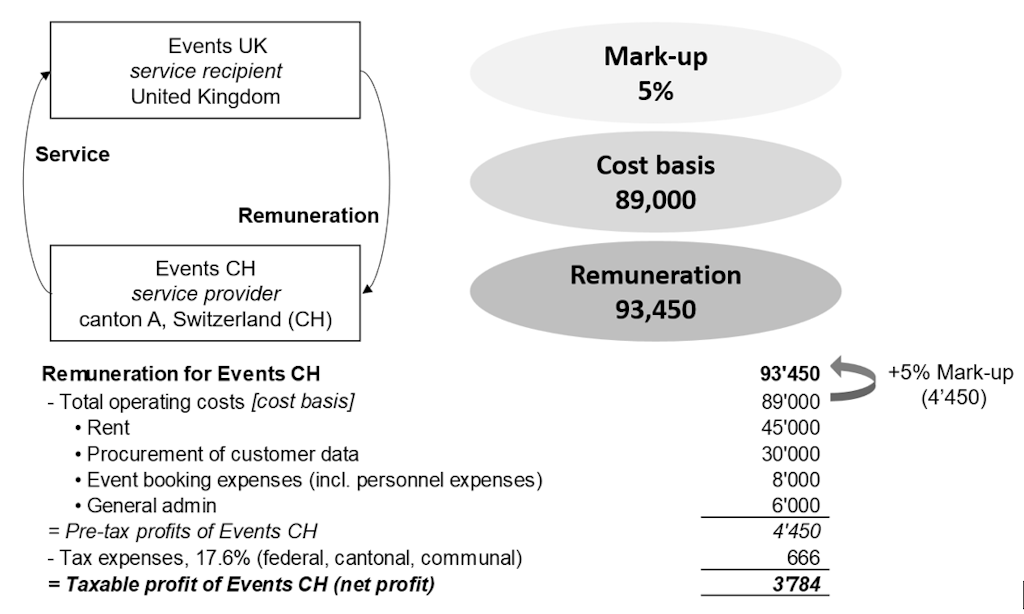
According to the OECD, pass-through costs in connection with third-party services should also be excluded from the relevant basis for calculating the mark-up.
For low value-adding services, the OECD allows a mark-up of 5% to be applied (referred to as the "simplified approach for low value-adding services"). This approach is aimed at reducing the administrative burden for tax administrations and taxpayers for certain types of services.
According to the OECD Transfer Pricing Guidelines, services are deemed to be low value-adding if they cumulatively meet the following four criteria:
- they are of a supportive nature,
- they are not part of the core business of the multinational enterprise group (i.e. not creating the profit-earning activities or contributing to economically significant activities of the multinational enterprise group),
- they do not require the use of unique and valuable intangibles and do not lead to the creation of unique and valuable intangibles, and
- they do not involve substantial or significant risk or give rise to the creation of substantial or significant risk.
The OECD Transfer Pricing Guidelines contain various examples of services that typically meet, or do not meet, these criteria.
In the case of low value-adding services, the OECD provides for the following administrative simplifications:
- The transfer prices are determined using a cost-based method with a fixed mark-up of 5% (excluding pass-through costs); the method itself and the 5% mark-up do not have to be determined using a benchmarking study;
- Transfer pricing is calculated using an indirect-charge method in which the cost allocation keys must be applied consistently for all recipients of the relevant service category;
- Requirements for the benefit test are reduced, i.e. for each service category, the taxpayer need only demonstrate that services have been provided;
- Documentation requirements are simplified, although these are of lesser importance, due to the lack of regulations on formal transfer pricing documentation in Swiss legislation.
Questions and answers in connection with primary, corresponding and secondary adjustment
Here you will find information on various transfer pricing topics in connection with cross-border transactions. This information is intended to provide clarification on selected issues. It is general in nature and cannot be used as the sole basis for the tax assessment of a specific fact pattern.
Primary adjustments are adjustments that are made by a first tax administration to a company’s taxable profits as a result of applying the arm’s length principle to transactions involving an associated enterprise situated in a second tax jurisdiction.
In Switzerland, primary adjustments are made exclusively by the cantonal tax administrations, as they are responsible for the assessment and collection of profit tax.
Example: primary adjustment
Company A, resident in Switzerland, pays CHF 50,000 in royalties to parent company B, resident abroad, which is the owner of a trademark. Company A then deducts these CHF 50,000 from its taxable profit as business-related expense. The cantonal tax administration is of the opinion that the price of CHF 50,000 does not comply with the arm's length principle and that two independent enterprises would have agreed on a price of CHF 30,000. The cantonal tax administration therefore adds CHF 20,000 to company A's taxable profit, which constitutes a primary adjustment.
Corresponding adjustments are adjustments to the associated enterprise's tax liability in a second jurisdiction which are made by that jurisdiction's tax administration as a result of a primary adjustment by the tax administration in the first jurisdiction in order to eliminate double taxation. It presumes that the primary adjustment is recognized by the second jurisdiction and, in its view, is based on a correct application of the arm’s length principle by the first tax administration. In practice, the corresponding adjustment occurs most frequently in mutual agreement procedures.
If a corresponding adjustment is made in Switzerland on the basis of a primary adjustment by the tax administration of a foreign jurisdiction, it also falls within the competence of the cantonal tax administrations insofar as it relates to profit tax.
Example: corresponding adjustment
Company A, resident in Switzerland, pays CHF 50,000 in royalties to parent company B, resident abroad, which is the owner of a trademark. The cantonal tax administration makes a primary adjustment so that CHF 20,000 is added to the taxable profit of company A. If the foreign tax administration does not take any action, this CHF 20,000 will continue to be considered as taxable profit for company B. Thus, the corresponding adjustment for the foreign tax administration consists of reducing company B's taxable profit by CHF 20,000, in order to make it consistent with company A's taxable profit and eliminate double taxation.
Repatriation payments are repatriations of profits that have been adjusted by a tax administration between associated enterprises that are parties to a transaction. They are used to reconcile the commercial balance sheet with the tax balance sheet resulting from the adjustment. These are not mandatory under either treaty law nor domestic law.
In application of Article 18 paragraph 4 of the Federal Act on the Implementation of International Tax Agreements (ITAIA), repatriation payments are not considered to be hidden profit distributions as defined in Article 4 paragraph 1 letter b of the WTA and are not subject to Anticipatory Tax (Swiss Withholding Tax), provided they are carried out in accordance with the results of a mutual agreement procedure or an internal agreement concluded on the basis of Article 16 of the ITAIA. In contrast, in the absence of a mutual agreement procedure or an internal agreement, Anticipatory Tax (Swiss Withholding Tax) is levied on the payments made for repatriation purposes.
Example: repatriation payments
Company C, based in a foreign jurisdiction, is subject to a primary adjustment for an intra-group transaction with its Swiss-domiciled subsidiary D, resulting in CHF 10,000 being added to company's C's taxable profit. Following a mutual agreement procedure to eliminate double taxation, Switzerland makes a corresponding adjustment by reducing company D's tax base by the amount of the adjustment made in the foreign jurisdiction, i.e. CHF 10,000. If company D subsequently repatriates the profits, i.e. if CHF 10,000 is repatriated to company C, no Anticipatory Tax (Swiss Withholding Tax) is levied on these profits.
Secondary adjustments are adjustments that arise from imposing tax on a secondary transaction. A secondary transaction is a constructive transaction resulting from the transfer of excessive remuneration, characterised as constructive dividends, constructive equity contributions or constructive loans, depending on the jurisdiction.
In Switzerland, a secondary adjustment represents the levying of Anticipatory Tax (Swiss Withholding Tax) on the amount that qualifies as a hidden profit distribution in the context of transfer pricing. Secondary adjustments in Switzerland are therefore carried out exclusively by the FTA, which has sole authority for levying Anticipatory Tax (Swiss Withholding Tax).
Example: secondary adjustment
Company A, resident in Switzerland, pays CHF 50,000 in royalties to parent company B, resident abroad, which is the owner of a trademark. The FTA considers that the price of CHF 50,000 does not comply with the arm's length principle and that the price agreed between two independent enterprises would be CHF 30,000. For the FTA, a secondary adjustment involves recognising the excess remuneration of CHF 20,000 as a hidden profit distribution, which results in the levying of Anticipatory Tax (Swiss Withholding Tax).
If a primary adjustment made by a cantonal tax administration is partly or fully confirmed in a mutual agreement procedure, the question of secondary adjustment arises, i.e. the levying of Anticipatory Tax (Swiss Withholding Tax) by the FTA on the amount of the primary adjustment confirmed in the mutual agreement procedure.
If the question of the levying of Anticipatory Tax (Swiss Withholding Tax) is not covered in the mutual agreement, Anticipatory Tax (Swiss Withholding Tax) is to be levied on the amount of the hidden profit distribution if the material and procedural criteria for collection are met.
Example: mutual agreement
Company A, registered in Switzerland, pays CHF 50,000 in royalties to parent company B, registered abroad, which is the owner of a trademark. The cantonal tax administration performs a primary adjustment of CHF 20,000 and adds this amount to company A's taxable profit. The primary adjustment leads to a mutual agreement procedure in which, under a mutual agreement, an arm's length price of CHF 40,000 is set for the royalties paid by company A to parent company B, which means that the primary adjustment of CHF 10,000 made by the cantonal tax administration is upheld. If the mutual agreement does not cover the issue of Anticipatory Tax (Swiss Withholding Tax), then Anticipatory Tax (Swiss Withholding Tax) is levied as secondary adjustment on the CHF 10,000 by the FTA if it considers that the criteria for a hidden profit distribution are met.
The mutual agreement may provide for the possibility that the taxpayer makes a repatriation payment of the amount of the confirmed primary adjustment; this should generally take place within 60 days after the taxpayer’s acceptance of the mutual agreement. If the taxpayer performs this repatriation, the secondary adjustment will not be made, i.e. the FTA will not levy Anticipatory Tax (Swiss Withholding Tax) on the amount of the adjustment confirmed by the mutual agreement. The payment must be documented towards the SIF, which forwards the relevant information to the FTA. However, the existence of such a reference in the mutual agreement does not oblige the taxpayer to make a repatriation payment. If no repatriation payment takes place, Anticipatory Tax (Swiss Withholding Tax) is levied on the amount of the primary adjustment in accordance with the applicable DTA.
The taxpayer does not have any right to have such a reference included in the mutual agreement – this depends on the circumstances of the individual case. In particular, the levying of Anticipatory Tax (Swiss Withholding Tax) is not waived in obvious cases of profit shifting.
Example: criteria for secondary adjustment
Company A, resident in Switzerland, pays CHF 50,000 in royalties to parent company B, resident abroad, which is the owner of a trademark. The cantonal tax administration performs a primary adjustment of CHF 20,000 and adds this amount to company A's taxable profit. The primary adjustment leads to a mutual agreement procedure, the mutual agreement stipulating an arm's length price of CHF 40,000 for the royalties paid by company A to parent company B, which means that the primary adjustment of CHF 10,000 made by the cantonal tax administration is upheld. If the mutual agreement contains a special indication with regard to Anticipatory Tax (Swiss Withholding Tax) and if the repatriation payment takes place in accordance with this indication, no Anticipatory Tax (Swiss Withholding Tax) is levied.
The repatriation must be carried out within the time limit specified in the mutual agreement, which is in principle 60 days from the transmission of the mutual agreement to the relevant cantonal tax authority.
In exceptional, duly justified cases, the FTA may, upon request by the taxpayer, grant an extension of this time limit.
The exchange rate to be applied to determine the amount in CHF that the Swiss company should receive under a repatriation should in principle be the exchange rate in effect at the time the hidden profit distribution was granted to the foreign company.
Can repatriation be carried out by netting a reciprocal receivable between the Swiss company and the foreign affiliated company?
The FTA will only accept repatriation in the form of an actual payment. Other forms of repatriation (e.g. netting, credit note, requalification of past contributions or dividends) do not avoid the Anticipatory Tax (Swiss Withholding Tax) consequences. When a repatriation has to be made in favor of the Swiss company, the foreign company cannot net a receivable that the Swiss company may have against it.
Exceptionally, the FTA will accept netting between different mutual receivables (different years or different transactions) if they are formally set out in the same mutual agreement or APA, or in a mutual agreement and APA concluded simultaneously and relating to the same matter.
Example: netting refused
Company A in Switzerland and foreign sister company B apply the profit split method to the joint development of intangible assets. The cantonal tax authority makes a primary adjustment to company A. The primary adjustment gives rise to MAP which confirms a primary adjustment of CHF 50,000. The mutual agreement contains a repatriation clause. Company B has a receivable of the same amount against company A for services rendered to company A that were not the subject of the MAP, and wishes to proceed with repatriation by waiving this receivable. Such a netting would not make it possible to avoid Anticipatory Tax (Swiss Withholding Tax) on the amount of CHF 50,000.
Example: netting allowed (mutual agreement)
Company A in Switzerland and foreign sister company B apply the profit split method to the joint development of intangible assets. The cantonal tax authority makes a primary adjustment to company A for the tax years 2021 to 2023. The primary adjustment gives rise to a MAP which confirms a primary adjustment of CHF 50,000 for the 2021 financial year and CHF 40,000 for the 2023 financial year. For the 2022 financial year, however, the MAP resulted in a hidden profit distribution of CHF 5,000 to company A. This distribution reduces the amount to be repatriated to company A from CHF 90,000 to CHF 85,000.
Example: netting allowed (mutual agreement and APA)
Company A in Switzerland and foreign sister company B apply the profit split method to the joint development of intangible assets. This transaction is subject to a MAP for the years 2021 and 2022, and an APA with retroactive effect for the year 2023 (closed for accounting purposes). The mutual agreement confirms a primary adjustment of CHF 30,000 for the 2021 financial year and CHF 25,000 for the 2022 financial year. For the 2023 financial year, however, the APA reveals a hidden profit distribution of 15,000 to company A. This distribution reduces the amount to be repatriated to company B from CHF 55,000 to CHF 40,000.
Does repatriation have to be carried out in the case of a hidden profit distribution by a Swiss parent company to its foreign subsidiary in violation of the arm's length principle?
A payment made by a Swiss parent company to one or more of its fully-owned foreign subsidiaries in violation of the arm's length principle does not, in principle, constitute a hidden profit distribution subject to Anticipatory Tax (Swiss Withholding Tax) under Article 4(1)(b) of the Withholding Tax Act. The FTA does not, in principle, make any secondary adjustments in such cases.
Even if such a payment is subject to a primary adjustment by the competent cantonal tax authority, which may be confirmed by a mutual agreement, there are no Anticipatory Tax (Swiss Withholding Tax) consequences and no repatriation is therefore necessary, in principle.
A bilateral or multilateral Advance Pricing Agreement (APA) is an arrangement concluded between the competent authorities of two or more States, at the request of the taxpayers, that determines in advance an appropriate set of criteria for the determination of the transfer pricing for intragroup transactions over a fixed period of time. If this agreement is then correctly applied by the taxpayers, there is no hidden profit distribution and therefore no Anticipatory Tax (Swiss Withholding Tax) consequences.
The question of secondary adjustment may, however, arise in cases where an APA has a retroactive effect, whether it concerns the years covered by a rollback or the years elapsed between the taxpayer's request for an APA and the signing of the APA.
If the retroactivity relates to years that have been closed for accounting purposes, a bilateral APA may provide for the insertion of a repatriation clause (such a clause is only relevant where there are consequences in terms of Anticipatory Tax (Swiss Withholding Tax), see previous question). If this repatriation is implemented by the taxpayer, the secondary adjustment will not be made, i.e. the FTA will not levy Anticipatory Tax (Swiss Withholding Tax) on the hidden profit distribution by the Swiss company to a foreign company. A repatriation clause cannot be included if the APA was opened after a secondary adjustment by the FTA.
If the retroactivity relates to years that have not yet been closed for accounting purposes, the transfer prices determined under the APA are implemented directly by the taxpayer before the accounts are closed. No subsequent repatriation is then necessary.
In the context of APAs with retroactive effect, some foreign competent authorities may sometimes refuse to include the repatriation clause in the APA.
In such a case, when the retroactivity relates to years that have been closed for accounting purposes, Anticipatory Tax (Swiss Withholding Tax) is levied on the amount of the hidden profit distribution, provided that the material and procedural conditions for its levying are met. The carrying out of a repatriation by the taxpayer does not therefore prevent the levying of Anticipatory Tax (Swiss Withholding Tax).
When the retroactivity relates to years that have not yet been closed for accounting purposes, the transfer prices determined within the framework of the APA are directly implemented by the taxpayer before the accounts are closed. In that case, no Anticipatory Tax (Swiss Withholding Tax) is levied.
A taxpayer who is the subject of a Anticipatory Tax (Swiss Withholding Tax) adjustment following an audit by the FTA may request the opening of a MAP.
If this secondary adjustment (i.e. Anticipatory Tax (Swiss Withholding Tax) on a hidden profit distribution) is fully or partially confirmed by the MAP, Anticipatory Tax (Swiss Withholding Tax) is due on the confirmed adjustment (the usual rules relating to the refund of Anticipatory Tax (Swiss Withholding Tax) remain applicable). It is not possible to insert a repatriation clause allowing Anticipatory Tax (Swiss Withholding Tax) to be avoided.
Example: mutual agreement
Company A in Switzerland pays royalties of CHF 50,000 to foreign parent company B, which owns a brand. The FTA makes a secondary adjustment of CHF 20,000, which is subject to Anticipatory Tax (Swiss Withholding Tax). The secondary adjustment gave rise to a MAP which, by mutual agreement, sets an arm's length price of CHF 40,000 for the royalties paid by company A to parent company B, partially confirming the secondary adjustment made by the FTA on an amount of CHF 10,000. The Anticipatory Tax (Swiss Withholding Tax) levied by the FTA on the amount of CHF 10,000 is therefore final.
The levying of Anticipatory Tax (Swiss Withholding Tax) on a repatriation to a foreign affiliated company outside a mutual agreement or domestic agreement under Article 16 of the Execution of International Tax Treaties Act, is based on domestic law. It does not result in taxation contrary to a double taxation agreement, which is why a MAP cannot be requested.
Questions and answers in connection with cost sharing arrangement
Such a legal construct exists neither in Swiss law nor in the OECD Transfer Pricing Guidelines. The OECD Transfer Pricing Guidelines recognise the cost contribution arrangement (CCA), a legal instrument that is partially similar to the CSA. A CCA is defined as a contractual undertaking which enables companies to share the contributions and risks associated with the joint development, production or procurement of intangible assets, tangible fixed assets or services, whereby, it is assumed that these result in a benefit for each of the participants. In principle, the costs of the CCA are shared and the profits are distributed according to the contributions made.
In the Altera vs. Commissioner decision, the US Tax Court ruled that the costs of stock options and stock-based compensations (SBCs) of employees who perform CSA-related activity must be included in the cost basis of the CSA.
In order to comply with the Altera decision, companies that are party to a CSA and subject to tax in Switzerland must increase the shared cost basis by the amount of the SBCs. As a result, the value of the developed asset is reduced.
The costs for SBCs under a CSA can be comparable to employee shareholdings or incentive programmes and, in the case of enterprises that are taxable in Switzerland and are party to such an agreement, are generally considered to be business-related expenses. However, each individual case must be assessed individually.
Questions and answers in connection with intra-group loans
Here you will find information on various transfer pricing topics in connection with cross-border transactions. This information is intended to provide clarification on selected issues. It is general in nature and cannot be used as the sole basis for the tax assessment of a specific fact pattern.
Certain administrative instructions issued by the FTA are applicable to financial transactions. These are namely the circular letters published annually by the FTA on the interest rate recognised for tax purposes for advances or loans in Swiss francs or foreign currencies, and FTA circular no. 6 of 6 June 1997 on hidden equity in corporations and cooperatives. These administrative instructions represent "safe harbour" regulations which are not binding for foreign tax administrations.
Chapter X of the OECD Transfer Pricing Guidelines contains specific guidelines for applying the arm's length principle to intra-group financial transactions, in particular treasury activities, including intra-group loans.
The FTA circular letters on interest rates recognised for tax purposes on advances or loans in Swiss francs and foreign currencies contain interest rates for different categories of transactions, and are intended to simplify the application of the arm's length principle. If taxpayers decide to apply the safe harbour rates, they do not have to demonstrate that the interest rate applied to a transaction complies with the arm's length principle, and a transfer pricing analysis is not necessary, provided that the transaction in question falls under the scope of the circular and the applied interest rate is in line with the rates in the circular.
On the contrary, non-compliance with these interest rates creates a rebuttable presumption of non-compliance with the arm's length principle. In this context, taxpayers have the option to demonstrate that the transaction complies with the arm's length principle and they are expected to demonstrate through a transfer pricing analysis, that the applied interest rate reflects the market rate and thus complies with the arm's length principle.
A transfer pricing study can be provided to demonstrate whether an interest rate that deviates from the interest rates set out in the FTA circular letters is in compliance with the arm's length principle. In practice, such a study is expected to include at least the following elements:
- A detailed description of the relevant transaction's main characteristics that could impact the interest rate. This description is important in order to identify the main factors for comparability and to delineate the transaction. These factors include the term of the loan, the currency, the issue date, the borrower's credit rating and the existence of guarantees and/or collateral.
- An analysis of the borrower's credit rating.
- A search for comparable transactions, taking into account the most important comparability factors.
The choice of currency is assessed on a case-by-case basis. The circumstances at the time of the transaction should be taken into account. The choice of a foreign currency must not be based solely on tax considerations.
Taking out a loan in a foreign currency loan may be justified in the following cases in particular:
- The foreign currency is the enterprise's functional currency.
- The foreign currency allows the enterprise to achieve more favourable terms. However, the costs of hedging the exchange rate risk must be taken into account.
- The foreign currency is the main currency of the income resulting from the use of an asset financed by the loan.
When conducting a transfer pricing analysis, it is important to distinguish between the rating of a borrower (issuer credit rating) and the rating of a financial transaction (issue credit rating).
The main difference is that the issue credit rating, which is based on the issuer credit rating, takes into account the specificities of the transaction and their impact on the credit risk assumed by the lender. As a result, the issue credit rating may be higher than the issuer credit rating. For example, a loan agreement may provide for a guarantee or a senior/privileged repayment, which reduces the credit risk and hence improves the rating. However, in other cases, the issuer credit rating may be higher than the issue credit rating. This may in particular happen if a loan is subordinated, as the lender will not be repaid until other loans have been repaid.
It is recommended to use the issue credit rating (rather than the issuer credit rating) to determine an arm’s length interest rate.
If a rating from an independent rating agency is available for a borrower, such rating should be used.
If no such rating exists, the rating must be estimated. There are various approaches:
- Use of methods defined and used by rating agencies;
- Use of software which allows the rating to be estimated based primarily on statistical models.
It is recommended that the methods used by one of the rating agencies be applied. However, the use of financial software is not excluded, provided that the reliability of the results can be demonstrated.
The issuer credit rating is a measure for determining the borrower's future ability to pay. It is therefore important to consider the impact of future transactions on the borrower's balance sheet, profit and loss account, and treasury function.
Nonetheless, it is appropriate to take historical financial data as a reference point, if such data can be considered to be sufficiently representative of future financial data.
Each rating agency applies its own standard. There are reliable comparison tables which can be used to convert a rating into one standard or another. The ratings of potential comparable transactions are mostly presented according to a standard set by one of the rating agencies.
It is therefore recommended that the standard of one of the rating agencies be used for a rating, although it is also possible to use other standards, provided that a reliable comparison or conversion table exists. However, the use of these other standards should make it possible to search for comparables without affecting the reliability of the results.
Banks are subject to special regulations to ensure their capital strength against certain risks and to protect customers from the risk of bank insolvency. They require an internal process for reliably assessing credit applications from enterprises. This internal process includes a financial rating system. Based on such rating system, banks set the conditions under which they will finance independent enterprises. Internal ratings of taxpayers in the banking sector can be accepted as comparables if it can be shown that they were estimated using the same methodology as the one used for their customers in calculating an interest rate.
The implicit support has an impact on the creditworthiness of a company, and hence on its credit rating. It must therefore be taken into account when estimating a borrower’s credit rating, as this rating determines to some extent the interest rate at which it can borrow.
Implicit support must be assessed on a case-by-case basis. It does not necessarily bring the same benefit to all companies in the group. If it appears that a borrower is receiving implicit support, its rating must be adjusted accordingly.
The rating of a company must be determined as if it were not part of the group (i.e. on a standalone basis). However, any implicit support must be taken into account.
In exceptional cases, the group credit rating may be used for the rating of a borrower. However, it must be demonstrated that it is the most reliable indicator in light of all the facts and circumstances. In particular, the company's creditworthiness indicators may not differ from those of the group (e.g. in the case of structures in which the group is owned by a succession of intermediate holding companies).
It is unlikely that there is only one interest rate on the market for a given transaction. It is therefore usual practice to set a range of arm's length interest rates. If the applied interest rate is within the interquartile range, it is usually accepted for tax purposes. The taxpayer must determine which specific interest rate he would like to apply and justify his choice. In this regard, it should be examined whether the chosen interest rate corresponds to the interest rate that an independent borrower (taking into account the terms of the transaction) would have received from a third party, and whether the taxpayer would have accepted it among other realistic options, based on the assumption that the borrower is seeking to optimise his weighted average cost of capital (WACC).
With regard to financial transactions, the OECD describes the specific methods which are used for determining an interest rate:
- The comparable uncontrolled price method (CUP method): according to the OECD, the CUP method is easier to apply for financial transactions than for other transaction types. This is due to the large number of markets and the availability of information for this type of transaction. The use of the CUP method is therefore widespread and is often preferred. The identification of internal or external comparables is a prerequisite for the use of the CUP method.
Depending on the conditions and circumstances, other methods may also be considered. In this regard, the OECD mentions the following methods:
- Cost of funds.
- Use of credit default swaps: credit default swaps are financial instruments comparable to insurance contracts for the assumption of credit risk in return for a risk premium. The results can be unreliable, as the limited degree of liquidity on the market for this kind of instrument leads to high volatility, as stated by the OECD. Thus, the spread applied to these financial instruments may partly reflect the liquidity problem observed on the markets for such instruments. In this case, it is not representative of market conditions. The use of credit default swaps is not recommended.
This is not an actual transaction, as the parties do not conclude a contract. The comparability criterion is therefore not met. Moreover, a bank opinion does not demonstrate whether an independent borrower would accept the same conditions or whether there would be other, more advantageous alternatives.
Against this background, a bank opinion can only serve as a starting point in exceptional cases, but is not sufficient to demonstrate compliance with the arm's length principle. As result, it is not recommended to use this method.
The application of the CUP method requires the identification of internal or external comparables. The FTA accepts bonds issued on the market and private financial transactions for which information is made available in databases as comparable transactions.
To identify comparable internal or external transactions, the selection criteria that have an influence on the interest rate must be defined based on the most important comparability factors. Key criteria are:
- Credit rating
- Effective (remaining) term
- Currency
- Issue date of the transaction
Once comparable transactions have been identified, it must be determined: i) which data should be used, and ii) whether an adjustment is necessary in order to determine an arm's length interest rate. Two types of data are relevant:
- The interest rate applied to comparable transactions: the interest rate is set at the moment when the relevant transaction is concluded. It corresponds to the markets' yield expectation at that time for this type of transaction, assuming a sale at nominal value. However, this interest rate does not reflect the market conditions at a later date. It is therefore not recommended to use interest rates of comparable transactions that were not executed close to the time of the transaction under review.
- The yields calculated for the comparable transactions: it is recommended to use yields that are calculated at a point in time close to that of the transaction under review. These yields reflect the current market conditions, regardless of when the comparable transactions were issued/executed. Due to the volatility of the markets, these yields should be calculated over a certain time period and an average should be used, in order to increase the reliability of the results.
It is not easy to find comparables in Swiss francs. Comparables in other currencies may therefore also be used. Given the proximity and economic interdependence between Switzerland and the EU, the use of comparables in Euros is recommended.
In this case, a reliable adjustment of the results is necessary to improve comparability. In practice, in most cases to make an adjustment it is appropriate to make an adjustment corresponding to the difference between a swap interest rate in Swiss francs and a swap interest rate in Euros for the same term.
Parties that have concluded a loan agreement can include a clause which entitles them, under certain conditions, to repay all or part of the loan before maturity.
The impact of early repayment clauses on the arm's length interest rate should be taken into account. It is therefore necessary to determine which party benefits from the clause and whether an actual benefit exists. In doing so, various factors such as the economic environment should be considered. If, for example, the markets expect a significant rise in interest rates, it is likely that the lender will activate the repayment clause and derive a benefit from this. Consequently, in such a context, the lender will probably be more inclined to accept a lower interest rate for the amount of the reduction in the risk associated with the loan. Conversely and under the same circumstances, a borrower would be more reluctant to negotiate such a clause. Finally, repayment clauses appear to be unrealistic for short-term, variable rate loans, as the risk associated with the interest rate volatility is lower in this context. A clause protecting against this risk does not seem appropriate.
Despite the end of the LIBOR, banks are continuing to grant variable rate loans. Thus, the use of a variable interest rate complies with the arm's length principle, provided that the interest rate applied also complies with the arm's length principle.
It is important to use a reference interest rate that is equivalent to those used in practice by financial institutions as a replacement for the LIBOR. These rates are determined according to new market standards that are set by stock exchange institutions or central banks that manage them. For the Swiss franc, this is the SARON (Swiss Average Rate Overnight). The LIBOR can be stated for various maturities (e.g. one day, one week, three months), whereas the alternative rate that was selected is a daily (overnight) rate. For this reason, methods exist for deriving a longer-term rate from this overnight rate, and these should be taken into account. For intra-group loans in Swiss francs, the option "last recent" and the SARON Compound Rate were selected.
The reference rate must be in line with the new market standards that are set by the stock exchange institutions or central banks that manage them. In particular, the following should therefore be considered:
- The new reference interest rates set for each currency;
- The duration of the LIBOR rate that was originally intended to be used for calculating the variable rate;
- The method for calculating longer-term reference rates from the new daily reference rates (e.g. SARON);
- Spreads that are calculated by the International Swaps and Derivatives Association (ISDA) according to a specific method and are supported by the banking sector. These spreads should ensure that the new reference interest rates are equivalent to the LIBOR rates with regard to risk.
Any change in the terms and/or conditions of an intra-group loan must comply with the arm's length principle. In this regard, it should, in particular, be assessed whether:
- revisions to the terms of the loan (e.g. duration, risk premium, use of a fixed interest rate) that were performed under the pretext of the end of the LIBOR were actually changed in compliance with the arm's length principle; [example 1]
- the possible termination of an agreement following the end of the LIBOR is in line with the original contractual terms and is justified on economic grounds; [example 2]
- the interest rates applicable from 1 January 2022 onwards were correctly calculated. On this assumption, an adjustment of the risk premium is in principle not justified. [example 3]
These different situations are illustrated with the following examples:
Example 1: Change in the terms of an intra-group loan
Background:
In 2021, the subsidiary of the ABC group (company A), based in Switzerland, receives a five-year loan of CHF 1 billion from another subsidiary (company B) of the ABC group. Based on a transfer pricing study, the contractually fixed interest rate for the loan between company A and company B is a variable rate corresponding to the three-month LIBOR plus a spread of 100 basis points (bps). Following the end of the LIBOR in 2022, the interest rate for the intra-group loan in question must be changed. For this purpose, a new transfer pricing study is performed on the basis of data that was available at the time when the loan was agreed between A and B in 2021. Based on this new study, from 2022 onwards, a fixed interest rate of 3% will be applied to the intra-group loan contracted in 2021.
Solution:
The primary criterion is what independent enterprises would have agreed in comparable circumstances. In this case, an independent bank would merely have informed its customers of the end of the LIBOR and the need to use an alternative interest rate for the outstanding loan agreement, with the alternative rate being the reference rate validated by the central bank. In addition, the bank would also apply the spread validated by the central bank, in order to ensure equivalence with the LIBOR rate.
Although a transfer pricing study was carried out, the interest rate applied from 2022 onwards (fixed rate of 3%) for the loan negotiated in 2021 does not comply with the arm's length principle. Under similar circumstances, independent enterprises that were previously bound by such a contract would have agreed to use an interest rate in line with the SNB's recommendations. This interest rate would correspond to the sum of the following rates/spreads:
- The alternative interest rate chosen by the SNB (SARON). An illustrative interest rate of 0.90% is used for the example.
- A spread adjustment as set by ISDA and recommended by the SNB. The spread of 0.0031% in the table corresponds to the spread calculated by ISDA for a three-month interest rate in CHF.
- The contractual spread (100 bps) to be applied to the reference rate, and originally agreed by the parties when signing the contract in 2021.
On the basis of the above, an arm's length interest rate is lower than the fixed rate of 3% applied from 2022 onwards. Consequently, from the 2022 tax period onwards, some of the recognised financial expense is not justified. This results in a hidden profit distribution, which needs to be determined on the basis of the following calculation:

Example 2: Termination of the intra-group loan agreement and issue of a new loan (early loan repayment)
Background:
Based on the same facts as in example 1, company A decides in 2022 to terminate the loan contract with company B following the end of the LIBOR. There is no compensation for this termination. A new five-year loan contract is agreed upon by the same parties. This new contract sets a fixed interest rate of 3%. This interest rate was calculated as part of a transfer pricing study based on data for comparable five-year loans that were negotiated between independent enterprises in 2022.
Solution:
In this case, several aspects have to be taken into account. Firstly, it must be examined whether the contract clauses permit early contract termination and, if so, under what conditions. As a rule, the end of the LIBOR is not one of the conditions that can lead to early termination of the loan. Secondly, in the conditions agreed between third parties, banks usually include compensation in the event of early contract termination, in order to ensure that they are not disadvantaged. Thirdly, it must be ascertained whether early termination is economically justified. In this regard, it can reasonably be assumed that the borrower would not terminate the contract if the current market rates, after taking into account any compensation due, were less favourable than the interest rate fixed at the time the contract was concluded. Based on these different elements, it can be inferred that a third party would not have terminated the contract early under similar circumstances. Therefore, company A's decision to prematurely terminate its contract with company B does not stand up to a third-party comparison.
Thus, in light of the above discussion, the financial expense recognised for tax purposes must correspond to that calculated on the basis of the interest rate provided for in the original contract, as early termination is not justified. After the end of the LIBOR, this interest rate corresponds to the interest rate calculated in example 1 in line with the SNB's recommendations (0.90% + 0.0031% + 1.00% = 1.9031%). The amount of the hidden profit distribution thus comes to CHF 10,969,000 (CHF 1 billion x (3% - 1.9031%)).
Example 3: Use of an alternative interest rate which is not in line with the SNB's recommendations (alternative interest rates)
Background:
Based on the same facts as in example 1, company B decides to replace the LIBOR rate with an alternative rate corresponding to the one-year interest rate swap (IRS) rate in its contract with company A. In 2022, this IRS rate was 2%, whereas the alternative rate recommended by the SNB (SARON) after adjustment to a variable three-month rate is 1.5%. The interest rates provided in this example are purely illustrative.
Solution:
In this case, an independent bank would have followed the SNB's recommendations, and would thus have calculated an interest rate based on the SARON and the 100 bps spread that was agreed between the parties when the contract was concluded in 2021. The interest rate that should be used from 1 January 2022 onwards is 2.5% (i.e. 1.5% + 100 bps). Consequently, for the 2022 tax period, part of the recognised financial expense is not a business-related expense and must be corrected. The hidden profit distribution amounts to CHF 5 million (i.e. 0.5% x 1 billion), as the interest rate paid by company A was 3% instead of 2.5% in accordance with the SNB's recommendations.
Questions and answers about Swiss tax statistics
The Federal Tax Administration raises over two thirds of all federal receipts. A general overview is provided in the publication «Tax statistics at a glance» (in German). Furthermore, there are detailed statistics on value added tax (in German) and direct federal tax (in German) as well as a detailed compilation of all federal fiscal revenues with a broad time perspective (in German).
Based on the data from direct federal tax (German), the FTA compiles statistics on the distribution of income and wealth in Switzerland.
Tax Freedom Day marks the first day of the year on which certain incomes no longer have to pay federal, cantonal and communal income tax. It reflects the average tax burden, in the Swiss cantonal capitals. Follow the link to access the Tax Freedom Day overview, broken down by year (in German).
Questions and answers about Swiss tax policy
For information on tax-related votes at federal level, see the votes on the website of the Federal Department of Finance FDF.
The current and completed consultations and hearings are listed on the website of the Federal Chancellery (the documents relating to the bills can also be found there): Consultations and hearings FDF (in German).
The FTA regularly commissions external partners to prepare appraisals and reports (in German) on tax issues. FTA staff regularly write reports on tax issues; these do not necessary reflect the official views of the FTA, the Department or the Federal Council.
Questions and answers for media representatives
Patrick Teuscher
Head of FTA CommunicationsNadine Ellis
FTA Communications SpecialistAdrian Grob
FTA Communications Specialist
Questions and answers about the FTA
The FTA generates the majority of federal receipts and makes an important contribution to the financing of public tasks. More information in the video.
The FTA puts the stakeholders – the taxpayers – at the centre. In future, the FTA will consistently offer services only electronically. The processing of bulk business will be digitalised step by step. A large number of procedures will be carried out purely automatically without manual intervention. The remaining cases, which are increasingly time-consuming due to their ever-growing complexity, can then be examined in greater detail. Strategy and objectives of the FTA (in German).