The cost plus method is based on the costs incurred by the provider of goods or services in an intra-group transaction. An arm’s length margin (mark-up) is then added to these costs, in order to achieve an appropriate profit. This method follows the basic principle that an enterprise strives to cover its costs while achieving a reasonable margin over the long term. The practical application of the cost plus method raises questions about the substantive and temporal cost basis on the one hand and the amount of the mark-up on the other.
Questions and answers in connection with the cost plus method
Here you will find information on various transfer pricing topics in connection with cross-border transactions. This information is intended to provide clarification on selected issues. It is general in nature and cannot be used as the sole basis for the tax assessment of a specific fact pattern.
In its circular no. 4 of 19 March 2004 (Circ. 4/04), the Federal Tax Administration (FTA) reiterated that the Director of the FTA had already informed the cantonal tax administrations in writing on 4 March 1997 that the OECD Transfer Pricing Guidelines were to be taken into account. Circ. 4/04 relates to the taxation of service companies, by which the OECD Transfer Pricing Guidelines must be considered when determining the remuneration of service transactions.
The OECD Transfer Pricing Guidelines have contained recommendations on the treatment of transfer pricing in connection with intra-group service transactions since the first version in June 1995. These recommendations, which have been supplemented and refined in the most recently revised versions of the OECD Transfer Pricing Guidelines (in particular in the 2017 version), are included in Chapter VII of the January 2022 version.
In the cost plus method, the mark-up for an intra-group transaction is calculated by comparing the margins achieved by third parties in comparable transactions in the open market. The cost plus method therefore requires a comparison of products, services, functions, risks, production complexity, cost structures and intangibles of the intra-group transaction with those of the uncontrolled transaction.
The comparability of the cost basis between the intra-group transaction and the uncontrolled transaction that was used to calculate the arm's length mark-up is very important. For the correct application of the arm's length principle, the cost basis of the transactions in the transfer pricing study should be calculated according to the same principles that were used for the intra-group transaction (identical profit indicator), as otherwise the range determined in the transfer pricing study is not comparable.
According to the OECD, a distinction must be made between operating costs, which generate added value, i.e. the expenses an enterprise regularly incurs for the purpose of continuing to operate business processes and systems and provide services, and non-operating costs such as taxes and financing costs. Financing costs are not usually incurred during the actual operating activity (at least in typical service companies and non-capital-intensive [routine] production enterprises), and do not generate added value. As non-operating costs do not contribute to a enterprise's added value, they are generally not included in the cost basis.
Background:
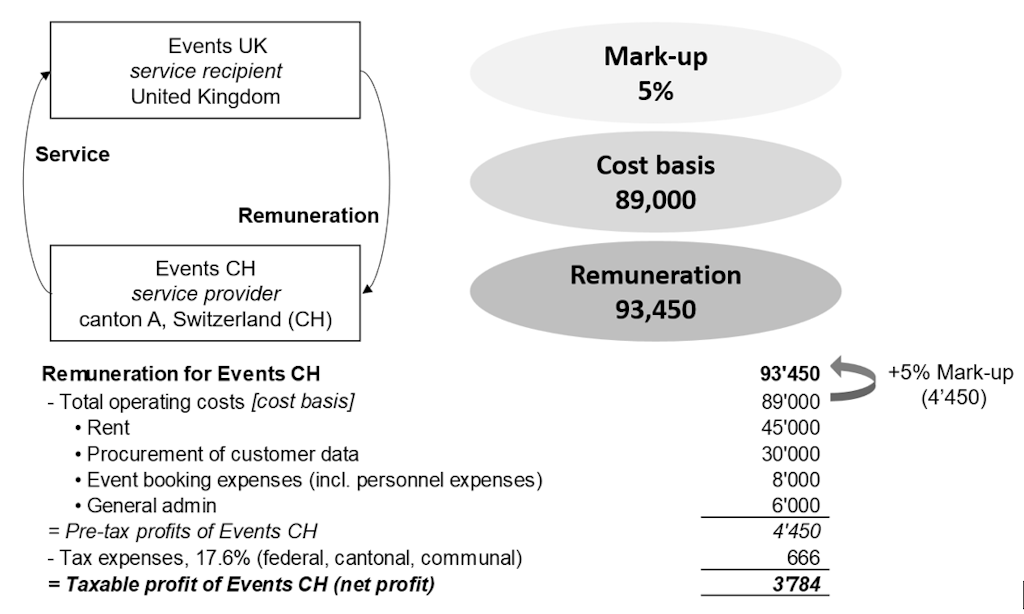
Events Switzerland GmbH, based in canton A (Events CH), supports its parent company, Events Global Ltd., based in the United Kingdom (Events UK), in the organisation of various events (concerts, theatre productions, art auctions, etc.) taking place in Switzerland. As the main organiser, Events UK is responsible for the marketing associated with these events, carries out the sales, sends out the invoices and negotiates the most important contracts itself. The business risk associated with the events is borne entirely by Events UK. Events CH has three staff members, who are responsible for dealing with the administrative aspects of events in Switzerland – this includes organising appropriate trade fair premises, clarifying all organisational aspects directly with the fair organisers, and negotiating the local rental contracts for the events. In addition, Events CH acts as the local payments processor for Events UK. As a pure payments processing platform for Events UK, Events CH calculates the fees and taxes due on the turnover from the event, and passes on the collected event turnover to Events UK. Events CH also bears no entrepreneurial risk in this respect. Events CH is compensated for its administrative support activities and the payments processing function by of cost plus method with a mark-up of 5%. A benchmark study confirmed that this mark-up complies with the arm's length principle.
Solution:
In accordance with the OECD Transfer Pricing Guidelines, local tax expenses are not included when determining the cost basis, which results in service income of CHF 93,450 for Events CH:
According to the OECD, pass-through costs in connection with third-party services should also be excluded from the relevant basis for calculating the mark-up.
For low value-adding services, the OECD allows a mark-up of 5% to be applied (referred to as the "simplified approach for low value-adding services"). This approach is aimed at reducing the administrative burden for tax administrations and taxpayers for certain types of services.
According to the OECD Transfer Pricing Guidelines, services are deemed to be low value-adding if they cumulatively meet the following four criteria:
- they are of a supportive nature,
- they are not part of the core business of the multinational enterprise group (i.e. not creating the profit-earning activities or contributing to economically significant activities of the multinational enterprise group),
- they do not require the use of unique and valuable intangibles and do not lead to the creation of unique and valuable intangibles, and
- they do not involve substantial or significant risk or give rise to the creation of substantial or significant risk.
The OECD Transfer Pricing Guidelines contain various examples of services that typically meet, or do not meet, these criteria.
In the case of low value-adding services, the OECD provides for the following administrative simplifications:
- The transfer prices are determined using a cost-based method with a fixed mark-up of 5% (excluding pass-through costs); the method itself and the 5% mark-up do not have to be determined using a benchmarking study;
- Transfer pricing is calculated using an indirect-charge method in which the cost allocation keys must be applied consistently for all recipients of the relevant service category;
- Requirements for the benefit test are reduced, i.e. for each service category, the taxpayer need only demonstrate that services have been provided;
- Documentation requirements are simplified, although these are of lesser importance, due to the lack of regulations on formal transfer pricing documentation in Swiss legislation.
Contact
Federal Tax Administration FTA
Team Transfer Pricing
Eigerstrasse 65
3003 Berne
Last modification 29.08.2025